

Introduction
The golden age of samba, a time period that spans roughly from the 1920s to the 1940s, primarily refers to the explosion of Rio de Janeiro–based musicians and performers like Donga, Pixinguinha, João da Baiana, Paulo da Portela, Noel Rosa, and Geraldo Pereira, among others. These individuals, along with the intervention of journalists, intellectuals, politicians, entrepreneurs, broadcasters, and fans, helped promote samba as the symbol par excellence of Brazilian national identity in the 1930s. It was only a question of time, though, until sambistas Footnote 1 would strive for new articulations of community and decolonization. The relentless drive of globalization and crackdown on civil rights, with the enactment of the AI-5Footnote 2 in 1968 under the military dictatorship, set the stage for what we might consider the second golden age of samba. From the 1960s well into the late 1980s, samba witnessed the rise of several prominent figures, particularly Zé Keti, Clementina de Jesus, Cartola, Antônio Candeia Filho, Dona Ivone Lara, Martinho da Vila, Paulinho da Viola, Nei Lopes, Roberto Ribeiro, and Bezerra da Silva. Nevertheless, critical studies on the abundant musical production of samba during the military regime continue to be outweighed by research on samba’s golden age.Footnote 3 This is unsettling for many reasons, not the least of which being that samba music and culture experienced unprecedented political obstacles in the 1970s that incited new questions, meditations, and praxes concerning its past, present, and future.
Divided into three sections, this essay first analyzes the impacts of the modernization of samba culture and the military regime on the samba community in Rio de Janeiro. It demonstrates, more concretely, how the need for creativity, improvisation, and freedom in making samba found its voice in partido alto.Footnote 4 The exploration of partido alto was not simply a priority for many sambistas but also a means of survival, fueling the rupture with the Portela samba school and the creation of the Grêmio Recreativo de Arte Negra Escola de Samba Quilombo in 1975.Footnote 5 The second section turns to police officer, leader and cofounder of Quilombo, and partideiro (practitioner of partido alto) Antônio Candeia Filho.Footnote 6 It has gone unrecognized for too long that Candeia was a samba preservationist and also a tropicalista, a defender of samba’s cultural roots, and a pioneer who procured those roots in black music sources as diverse as Brazil, the United States, the Caribbean, and West Africa. Despite this, his awareness of foreign cultural domination in Brazilian society and his unease with (African) American politics made him unsympathetic with Pan-Africanism.Footnote 7 The aversion to Pan-Africanism becomes especially apparent in the third section, where I explore Black Soul in the late 1970s and its reception in Rio’s samba community. As Black Soul triggered debates on Brazilian racial and cultural politics, sambistas such as Candeia, Elton Medeiros, Clementina de Jesus, and Dona Ivone Lara, among others, regarded Black Soul as a threat to the primacy of samba music and culture.
Improvisation Above All Else: Partido Alto as Method
The largest slave colony and the last to abolish slavery in the New World (in 1888), Brazil imported over 5.6 million Africans from the sixteenth century to the middle of the nineteenth century. This estimate excludes Africans who died on slave ships (Reference Faria and VainfasFaria 2002, 237). At present, Brazil’s black population is second only to that of Nigeria. Since the enslavement of Africans in the New World, dark skin and black culture have signified undesirability and inferiority. The undervaluing of Afro-Brazilians and their culture shifted in the early twentieth century as the scientific and artistic sectors of Brazil reevaluated the potential Afro-Brazilian contributions to the enterprise of nation building. The cultural nationalism of Brazilian modernismo in the 1920s, and the rapid development of commercial radio and the record industry, the rise of author’s rights associations, and the growing popularity of samba in the 1930s, are some of the factors that conspired to make that musical genre the ultimate synthesis of national identity.Footnote 8 From then on, Brazil would portray itself as a land composed not of whites, blacks, and indigenous peoples but of mestiços.Footnote 9 Samba would be evidence to the rest of the world of Brazil’s “racial democracy.” Operating as a racial ideal among the Brazilian elite since at least 1920, and introduced as a concept by Gilberto Freyre in his classic 1933 oeuvre Casa-grande & senzala (The Masters and the Slaves) in response to racist interpretations by Oliveira Vianna and others, the ideology of “racial democracy” advances the fallacious view that Brazil is free of racial prejudice and discrimination, and that consequently, blacks and whites are afforded equal social and economic opportunities (Reference HasenbalgHasenbalg 1979, 242; Reference Skidmore and FontaineSkidmore 1985, 13).
Ever since the early twentieth century, samba music and culture have encompassed spaces through which musicians could express their sociopolitical desires and frustrations. According to leading scholar of media and Afro-Brazilian culture Muniz Sodré, sambistas are black politicians insofar as they embody a collective movement or political action that intends to affirm a social group from “below,” and not from the state, or “above,” as Realpolitik.Footnote 10 By political, I am referring specifically to Jacques Rancière’s concept of the “distribution of the sensible,” the notion that one’s occupation determines the ability or inability to take charge of what is common to the community, what is seen and what can be said, who has the ability to see and the talent to speak, around the properties of space and the possibilities of time (Reference Rancière and RockhillRancière 2004, 12–13). The political citizen, therefore, is the one whose occupation is not waiting elsewhere but is predicated on free movement in the city, like that of the sambista.
If it is true that sambistas are black politicians, what kind of politics have they envisioned? How might their politics have shaped or contested local, national, and global imaginaries of music, race, and community in Brazil? Why is samba music and culture in the 1970s so significant in this regard? After conducting extensive research, I agree with Nei Lopes and Sérgio Cabral that Afro-Brazilian militancy in samba lyrics and cultural politics took force in the 1970s with Antônio Candeia Filho, Nei Lopes, Luiz Carlos da Vila, Martinho da Vila, and, to a lesser degree, Paulinho da Viola.Footnote 11 Candeia’s partido alto “Dia de Graça” (1970) is key, for it signals the first explicit call to Afro-Brazilian militancy in samba lyrics.
In “Dia de Graça” (Day of Grace) (1970), the lyrical voice refers to Afro-Brazilians as “blacks” and interprets Rio’s carnival as an “illusion” after which they will return to their shacks.Footnote 12 For this reason, the lyrical voice demands that blacks not deny race as a determining socioeconomic factor in Brazilian society. To ameliorate their lives, blacks must “wake up” and face the racial segregation outside of carnival.Footnote 13 Blacks, following the lyrical voice, should be “kings” not just in carnival but also in society. The verse “sing a samba in the university” is an allusion to the importance of allowing younger generations of blacks to study in the universities and break the cycle of social, economic, and racial segregation.Footnote 14 Throughout the 1970s, black discourses within Rio’s samba community were compounded of several variables, ranging from the modernization of samba music to the perceived threat of national and foreign music and cultural politics. A valuable point of entry into these issues can be found in the Renascença Clube.
Established in Lins de Vasconcelos, Rio de Janeiro, on February 17, 1951, the Renascença Clube or “Rena” was conceived as a social, recreational, sportive, and cultural space that served to promote solidarity among members and families. The Renascença opened its doors in response to black segregation that Afro-Brazilians experienced while trying to attend clubs in Rio de Janeiro. In the early 1970s, the new directors of Renascença would redefine their political vision by rejecting the elitism and moralism of the club in the 1950s—and the samba project of the 1960s—that situated blacks, and especially black women, in a position of subordination and manipulation. The new group of directors in the 1970s became indignant with how samba and samba culture sidestepped racial questions and encouraged middle-class whites to fetishize Afro-Brazilian women.
Inspired by the film and television series Shaft, Renascença’s “Shaft Night,” which began in 1972, united the inhabitants of Rio’s low-income black communities to bolster their self-esteem and identity by celebrating black pride to the sounds of soul music and African American cultural expression. In lieu of extolling their brasilidade (Brazilianness), attendants forged transnational identifications of black diaspora with the United States, recreating ways of being black and Brazilian. In interviews with Shaft Night attendees, Sonia Maria Giacomini illustrates the wave of insensitivity and reductionism mounted against them; detractors reproached them as imitators of US music while exposing general Brazilian insecurities such as, “Why doesn’t Shaft play Brazilian music?” For these reasons, founders and Shaft attendees concurred that samba and samba culture were conformist and reinforced the racist status quo (Reference GiacominiGiacomini 2006, 216).
Around this time, several sambistas responded to the descaracterização (disfiguration) of samba music.Footnote 15 During perhaps Brazil’s most memorable World Cup event in history, in 1970, General Emílio Garrastazu Médici turned his attention to soccer and samba as the prime movers of nationalist euphoria. In 1970, there appeared a more political samba that “linked the old familiar rhythms with themes directly inspired by a regime eager to blend samba melodies and football triumphs in a vigorous campaign for popular support” (Reference FlynnFlynn 1971, 327). While it is true that popular music identified as critical of the military regime or at odds with its values was subject to censorship, Paulo Cesar de Araújo (Reference Araújo2003) and Gustavo Alonso (Reference Alonso2011) demonstrate, contrary to other scholarship, that many artists also, sang, supported, and desired the glories of the dictatorship.Footnote 16 A catchy marcha, Miguel Gustavo’s “Pra Frente Brasil” (Forward Brazil) was adopted as virtually the theme song of the dictatorship.Footnote 17 Played by army bands at presidential reviews and official occasions, and repeated on radio and television, “Pra Frente Brasil” was ubiquitous. After 1970, coincidentally, the “legitimate” samba-enredo—a type of samba composition associated with carnival—experienced profound and undesirable transformations due to “the measured time of the processions and the excessive number of participants. The sambas-enredo of the present have a very accelerated tempo, easy rhymes and lyrics” (Reference EliasElias 2005, 208). In the midst of this, however, lurked a more organic, long-standing, and free-spirited protagonist who would confront the overarching ideology that framed samba’s new velocity: partido alto.
Narrated by the soothing voice of Paulinho da Viola, Leon Hirszman’s 1976 documentary Partido alto, which was released in 1982, provides indispensable counternarratives to the accelerated and chronometrically rigid styles of samba previously mentioned.Footnote 18 Highlighted by many scholars (Reference CarneiroCarneiro 1961; Reference LopesLopes 1992; Reference SodréSodré 1998; Reference SandroniSandroni 2001; Reference HertzmanHertzman 2013; Reference Lopes and SimasLopes and Simas 2015), partido alto is often emphasized as the “traditional” or “authentic” samba.Footnote 19 For Candeia, Manacéia, and da Viola, among other sambistas, partido alto encapsulated various forms of musical expression, language, and identity that were local and intimate. In Partido alto, Candeia remarks on how the variants of partido alto displayed in the samba school Portela were on the brink of extinction. Typically, the cavaquinho, a small, four-stringed guitar resembling a ukulele, would stand alone, and more instruments would gradually adhere to the spirit of the work being crafted. The sounds of the cavaquinho, household dishes, and the absence of a chorus, constituted the ballast of the roda de samba.Footnote 20 Affiliates of the Portela samba school also had a unique way of dancing partido alto, whose trademark was the placing of hands on hips.
Improvisation, a hallmark of brasilidade, mounted concerns for partideiros as they could not help but notice the mix of indifference and difficulty that it posed for sambistas at large. For some Brazilians, improvisation has epitomized the nation’s ills such as underdevelopment, impunity, and social inequality, while for others it holds the promise of a new stage of humanity in a globalized world (Reference StanyekStanyek 2011, 5). To Paulinho da Viola, the roda of partido alto represented a moment of liberty and of improvised verses; a mode of resistance to the compromises and reduction of creativity in samba enforced by the limits of carnival (Reference HirszmanHirszman 1982). Recorded in 1975 on the album Paulinho da Viola, Da Viola’s samba “Argumento” (Argument) condemns the disfiguration of samba: “That’s fine, I accept the argument/But don’t alter my samba like that” (Reference Da ViolaDa Viola 1975).
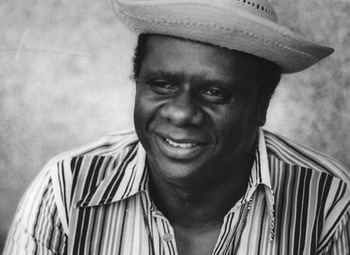
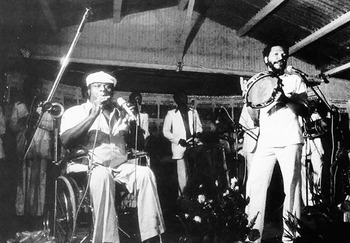
A number of sambistas became indignant with the rapid modernization of samba schools, and above all, Portela. On March 11, 1975, with the support of Carlos Monte, Paulinho da Viola, Claudio Pinheiro, and André Motta Lima, Candeia submitted a letter to Portela’s president Carlinhos Maracanã that critiqued the school and offered a list of suggestions to overcome its obstacles. As their concerns fell on the deaf ears of Portela’s administration, the group left Portela to form the Grêmio Recreativo de Arte Negra Escola de Samba Quilombo (Reference SimasSimas 2012, 89–91). Erected in late 1975, Quilombo styled itself as a movement of resistance against the disfiguration of samba’s cultural roots (see Figures 1 and 2). The balance between samba preservation and evolution, however, had been addressed as early as 1962 by an array of music composers, interpreters, sambistas, researchers, and enthusiasts at the Primeiro Congresso Nacional do Samba (First National Congress of Samba), held at the Palácio Pedro Ernesto in Rio de Janeiro.Footnote 21 Coauthor of samba classics like “Peito Vazio,” “Madrugada,” and “Onde a Dor Não Tem Razão,” legendary sambista Elton Medeiros decried the conversion of Rio’s samba schools into a “bolsa de valores” (stock exchange).Footnote 22 Beginning in the 1960s, observes Medeiros, the board of directors of samba schools passed to the hands of rich businessmen who had no love or belief in samba (Correio Braziliense 1977, 12). One of Quilombo’s counterstrategies to the spectacle of carnival dominated by high-paying white tourists was to eschew funding from the tourist agency in favor of a low-budget, participatory spectacle that exhibited Quilombo’s own principles (Reference RaphaelRaphael 1980, 125, 160; Reference McCannMcCann 2002, 45). Some of those principles were providing free food and entry to their headquarters, projecting films on black culture, offering varied musical styles like partido alto and caxambu,Footnote 23 playing the card game sueca, and having conversations and telling stories.Footnote 24
While I do not propose to name all contributors, suffice it to say Quilombo counted on a wide network of musicians, many from the Portela samba school (Paulinho da Viola, Casquinha, Waldir 59, Elton Medeiros, Jorge Coutinho, Nei Lopes, Martinho da Vila, Clara Nunes), journalists (Waldinar Ranulpho, Clovis Scarpino, Juarez Barroso, Lena Frias), and organizations such as the Instituto de Pesquisa das Culturas Negras (IPCN, or the Research Institute of Black Cultures) and the Centro de Estudos Afro-Asiáticos (CEAA, or the Center of Afro-Asian Studies).
In an interview published in the newspaper Última Hora in January 1976, Candeia elaborates on Quilombo’s racial tolerance and decodes the meanings of disfiguration in samba schools: “The resistance is mainly against the disfiguration of samba schools. From now on, we want to ensure that people will continue to know what a samba school was and what sambistas were, how and why sambistas got together, sang, danced, and used their own traditional rhythm. What we will rebuff are blacks and whites who intend to ‘innovate’ samba, thereby soiling its character and removing it from its cultural roots. Our objective is to protect the essence of the origins of our samba” (Reference VargensVargens 2008, 74–75).Footnote 25
Here, Candeia’s reflections overlap with those of others on partido alto and its importance as a pedagogical treatise of samba’s cultural roots, as seen in Hirszman’s Partido alto (Reference Hirszman1982). Coauthored with Isnard Araújo, Escola de samba: Árvore que esqueceu a raiz (Samba School: Tree That Forgot the Root) (1978) exposes Candeia’s and Araújo’s sociological perspectives on power structures, samba culture and schools, and racial hierarchies in Brazilian society. Perhaps most intriguing is how the authors entangle themselves in a thorny push-pull dynamic. On the one hand, they critique the monopoly of white Brazilians in politics, economics, educational privileges, and well-being; on the other, they acquit the middle class from contributing to the disfiguration of samba schools. For Candeia and Araújo, samba is of the “Brazilian nation,” its schools of “natural” and “spontaneous” development, and its problems of “economic and social order” (Reference Candeia Filho and AraújoCandeia and Araújo 1978, 83, 90). In this way, Candeia and Araújo refrain from a thorough discussion on the institutional and societal causes and consequences of the evolution of samba schools as characteristic of Brazilian race relations discourses. As previously noted and detailed in the following analysis, Candeia was reluctant to see the struggles of Afro-Brazilians mirrored in those of Afro-descendants worldwide in musical genres like soul, rumba, and reggae. His mission was to ensure the survival of Brazil’s “national music”: samba.
Antônio Candeia Filho: Preservationist and Tropicalista
Foreign music was not exactly Candeia’s nemesis. On one occasion, his son Jairo recalled how his father listened to a more “elite” strain of American music like Nat King Cole. Elton John was also one of his favorites. “When I came home one day he was singing ‘Rocket Man,’” recounts Jairo (Reference WatzlWatzl 2010). Candeia did not just enjoy listening to foreign music, he reinvented samba with a tropicalist approach that is evident in his embrace of African, US, Caribbean, and Brazilian musical influences.Footnote 26 As Bernardo Oliveira (Reference Oliveira2015) argues, Candeia’s act of resistance manifested itself in his defensive act of preservation, not in the positive act of creation.
Despite signs of Candeia’s adoption of foreign music in the early 1970s, he came to assail young Brazilians’ identification with it and took aim at the Brazilian media for prioritizing foreign cultural products over Brazilian ones. Lamenting the “lack of options” or “opportunities for choice,” he avowed, “We are inclined to do what consumer marketing imposes on us” (Reference Bacellar, Couto and RochaBacellar, Couto, and Rocha 2008). Perhaps even more emphatically, Quilombo cofounder Elton Medeiros asked, “How can we remain with our arms crossed when 80 percent of the music on the radio is foreign?” (Correio Braziliense 1977, 13). In Que horas são? Ensaios (Reference Schwarz1989), Roberto Schwarz argues that progress and social prestige in Latin America hinge on a perceived superiority and deification of the cultural products of First World nations. A proud and ebullient Afro-Brazilian musician, Candeia was allergic to this psychological current, and made it clear whenever afforded the opportunity to do so.
The political complexity embedded in what has proven to be a largely uneven transnational musical exchange between the United States and Brazil dates back to the early twentieth century.Footnote 27 Upon their return from Paris in 1922, the acclaimed music composer and choro bandleader Pixinguinha and his group, the Oito Batutas, were sneered at for being “corrupted” by the influence of American jazz and using instruments such as saxophone and trumpet. The bossa novistas also harbored their own qualms. Carlos Lyra’s “Influência do Jazz” (Influence of Jazz) (Reference Lyra1963) speaks to the slavish emulation of jazz and its incorporation to Brazilian musical styles. Not exclusively characteristic of the political climate during João Goulart’s presidency from 1961 to 1964, Lyra, like many left- and right-wing nationalists, sought the “residual,” which upon subtraction, would render the “authentic substance” of Brazil (Reference SchwarzSchwarz 1989, 33).
This theoretical credo rang true on July 17, 1967, when approximately four hundred demonstrators, among them musicians such as Elis Regina, Gilberto Gil, Geraldo Vandré, Jair Rodrigues, Edu Lobo, and Zé Keti, marched from the Largo São Francisco to the Teatro Paramount on Avenida Brigadeiro Luís Antônio in São Paulo, protesting the electric guitar with the slogan “Abaixo a guitarra!” (Down with the guitar!). For some, the electric guitar symbolized the invasion of “Yankee imperialism”; for others, it typified the overbearing presence of commercial—usually meaning distasteful—US music in Brazil. Positions on the issue were dissonant and in some cases, as time would tell, regrettable. Whereas Caetano Veloso and Nara Leão were against the march, musicians like Gilberto Gil—who did not consider himself “an ideological defender of territories”—saw it as a “healthy dispute of people with different visions.” Researcher of Brazilian popular music Sérgio Cabral, in contrast, admitted publically decades later that the march against the electric guitar was “ridiculous” (Reference Terra and CalilTerra and Calil 2010).
Candeia, among others, was not immune to the disfiguration of samba, the growing popularity of US soul music, nor the Brazilian media’s “overvaluing” of foreign cultural products.Footnote 28 In fact, his lack of enthusiasm with Pan-Africanism can hardly be imagined free of these considerations. When asked whether Afro-Brazilians who adopt foreign musical models are seeking racial identification and unity, Candeia discarded the possibility, deeming Brazil’s problems unique. In Candeia’s view, the curative recipe for Brazilians would be “to encounter solutions within our own principles, within our own culture, within our modus vivendi, and not to imitate or import things that come from other countries” (Reference Bacellar, Couto and RochaBacellar, Couto, and Rocha 2008).
As US soul music had already achieved local coinage and expression as “Black Rio” in Brazil, in May 1977, Candeia and writer Cecília Jucá exhibited critical diasporic commentary on Brazil, the United States, and Africa in an interview with the magazine José: Literatura, crítica & arte:
Candeia: I do not intend to imitate anything that is related to American blacks which does not interest me. I return to African culture, the mother culture. As such, African culture suffered a process of violence. I consider black Brazilians to be the greatest cultural heirs of Africa. American blacks are completely left out; they suffered a total brainwashing, and because of this, are no longer connected to their origins.
Cecília Jucá: [American blacks] contributed very little to the diverse forms of cultural expression. Not in music, but in other forms of expression like the culinary arts, there was no miscegenation in American society (Reference Candeia FilhoCandeia Filho 1977a, 4).
Candeia and Jucá manifest a commonly misguided understanding of US history that considers American blacks to be stripped of their origins. They also deny the United States’ membership into the miscegenation club.Footnote 29 Certainly not alone, Brazilian anthropologist Antônio Risério contends dogmatically that in the United States, “African cultures were destroyed, swept off the map” (Reference Risério2009, 116). Risério cautions social scientists not to transfer the United States’ historical reality to Brazil; yet, ultimately, he performs the same operation, albeit inversely. The United States would forfeit its Africanness only if one were to subject it to Risério’s categorizations of what he considers African origins to be. To Risério, African origins are nonexistent in the United States because there are no orixás, practices and symbolic systems of African origin, and there are too many blacks spending time “hugging the Bible” (Reference Risério2009, 116).
Writers and activists of Afro-Brazilian culture Abdias do Nascimento and Elisa Larkin Nascimento challenge the much-touted idea of religious “syncretism” in Brazil. For them, African religion in Brazil has been thwarted by constant institutional surveillance and white co-optation (Reference Nascimento and Nascimento1992, 155). Furthermore, to argue retrospectively that white landowners and Protestantism hindered religious syncretism in the United States more than in Brazil neglects that Africanness is a process of designification and resignification. Keeping this in mind, in spite of the United States’ policy limitations in Africa, the country has provided a focus of interest for contemporary Africa that has no counterpart in contemporary Brazil (Reference Dzidzienyo and FontaineDzidzienyo 1985). It is also critical to notice how Jucá’s, Candeia’s, and Risério’s position silences the extensive historical debates regarding the branqueamento (whitening) of Afro-Brazilians.Footnote 30 These points are reminiscent of the Shaft attendees’ observations in the early 1970s that labeled samba and samba culture as conformist and preservationist of the racist status quo for denouncing transnational identification among Afro-descendants. As we shall witness in the ensuing section, Black Soul would disrupt, albeit temporarily, the logic of Brazilian exceptionalism and the primacy of samba in Rio de Janeiro.
Racial Comparison and Musical Competition: The Case of Black Soul
In the late 1970s, the US-inspired cultural movement dubbed Black Soul or Black Rio erected transnational semiotic codes among Brazilians, and most notably, Afro-descendants.Footnote 31 Cultural products of black protest and empowerment circulated to varying degrees in literature with Frantz Fanon’s Black Skin, White Masks (1952) and The Wretched of The Earth (1961), Stokely Carmichael’s Black Power (1967), and Eldridge Cleaver’s Soul on Ice (1968); in film and documentaries with the starring roles of football player and actor Jim Brown, and Mel Stuart’s Wattstax (1973); and in music with the celebration of black power anthems like James Brown’s “Say It Loud, I’m Black and I’m Proud” (1968).Footnote 32 The surge of black empowerment in the north blossomed on Brazilian soil, propagating verbalizations of US and Brazilian cultural and racial politics. Reference FriasLena Frias’s 1976 article “Black Rio: The (Imported) Pride of Being Black in Brazil” set the tone of how the racial imaginary encoded in soul styles threatened venerated images and narratives of Brazilian national identity.
In hopes of reinstating the ideology of racial democracy, the Brazilian military criticized Black Soul while garnering support by wealthier civilians who opposed the dictatorship yet believed that the fans of Black Soul were espousing racial hatred and conflict. Black Soul also caused alarm due to independence from and resistance to white elite definitions of national “Brazilianness” and Afro-Brazilian cultural practice (Reference HanchardHanchard 1994, 114). For the director of WEA Discos Ltda. André Midani and the leader of the Soul Grand Prix dance party, Asfilófilo de Oliviera Filho (“Dom Filó”), it was inadmissible that white people in the more affluent Zona Sul of Rio could wear jeans, bop to rock, and idolize Mick Jagger, while blacks in the more destitute Zona Norte could not sport zappy clothes, groove to soul, and idolize James Brown. In Filó’s view, as in others’, blacks were expected to remain in the morros (hillside shantytowns) so as to bar an “eventual competition in the job market” (Veja 1976, 158).Footnote 33 As a reformed branch of Brazil’s long-existing secret or “political” police, which had investigated black organizations like the Frente Negra (Black Front) in the early 1930s and the TEN in the 1940s and 1950s, the Departamento Geral de Investigações Especiais (DGIE, General Department of Special Investigations) political intelligence wing carried out investigations into the soul phenomenon as early as April 1975 (Reference AlbertoAlberto 2009, 8).
Other African diasporic musical genres like reggae, for example, garnered a warmer reception in Brazil than Black Soul. When Bob Marley paid a visit to Rio de Janeiro in 1980, he declared, “samba and reggae are the same thing, they have the same feeling of African roots” (Reference Pinho, Perrone and DunnPinho 2001, 195). Marley’s parallelism between samba and reggae is, to say the least, intriguing. In my analysis, there are at least three reasons why reggae did not engender national discomfort in Brazil from the 1970s on: albeit an “offspring” of soul, reggae music represented, at the time, the small Caribbean island of Jamaica and not US empire; the political imaginary of famed reggae artists like Bob Marley and Jimmy Cliff was not as overtly racially charged as soul; and, unlike in Salvador and São Luís where reggae music gained traction in the 1970s, reggae only began to catch on in Rio de Janeiro, São Paulo, and Southern Brazil in the 1980s, after Candeia’s death in 1978 and Black Soul’s waning popularity.Footnote 34
The divergent tonalities in the reception of reggae and soul in Brazil lend some credibility to Gerard Béhague’s claim that there can hardly be such a thing as a unified African diaspora given the ethnohistorical differentiation of the Afro-American communities in the Western Hemisphere (Reference Béhague2002, 9). As we will continue to witness, though, the variable of differentiation is not simply an ethnohistorical question: Rio’s black population in the 1970s constituted ideological positions that ranged from the distaste of Afro-diasporic cultures to their celebration, thereby deflating the fantasy of a coherent local or national black community.
In 1977, the legendary anthropologist Gilberto Freyre warned Brazilians in an article published in the Diário de Pernambuco entitled “Attention Brazilians” that Brazil should not let itself fall prey to the “militant Marxism of hatred” of the jealous United States, for Brazil is a “fraternally brown nation” where “sambas are almost all happy and fraternal.”Footnote 35 In his conservative status quo idealizations, Freyre conjectured that “there is no ‘Black Brazilian’ separate from the national Brazilian community. There exist Brazilians of Black-African origin, some of which suffer discrimination, not of a racial character, but of class” (Reference HanchardHanchard 1994, 115, 127). As Muniz Sodré correctly points out, when Freyre speaks of Brazilian culture, he establishes a hierarchy in which the Iberian elements stand out above the African and indigenous ones (Reference Sodré1988, 163).Footnote 36 Freyre assumes the classical Brazilian position that is shared by many contemporary intellectuals, which stipulates that racial discrimination is not a Brazilian problem but a foreign one.Footnote 37 For thinkers like Freyre, Brazilian identity is national and unified and intolerant of ethnic discourses. This disposition forgoes the inclusion of Afro-Brazilian voices in the construction of racial categories and discourses in both public and institutional spaces. It is reasonable to consider that—like many intellectuals throughout post-abolitionist societies in the Americas—Freyre might have been fearful that as Afro-Brazilians became politically empowered, they would “revolt” or gain control over their representation and objectives.Footnote 38
The transition from historical object to subject seemed increasingly viable for many Afro-Brazilians at the time. In the latter half of the 1970s, the IPCN realized connections with the soul dances that had become popular among Rio’s black youth in earlier years. For members of the IPCN, and most notably the Sociedade de Intercâmbio Brasil-África (SINBA, or Society for Brazilian-African Exchange), getting Brazil’s majority officially recognized as black and not a whitened or mixed nation became one of its most urgent endeavors (Reference AlbertoAlberto 2011, 266, 275).
As critics labeled bossa nova in its emergence as “un-Brazilian,” several prominent sambistas, Afro-Brazilian activists, and samba schools had similarly opposed Black Soul, not only for its “cultural inauthenticity” but also because of its perceived invasion of their turf and their own shrinking islands of cultural relevance (Reference HanchardHanchard 1994). What became unsettling for Martinho da Vila, Monarco, and most sambistas was seeing outsiders rent and occupy the space of the samba schools so they could listen and dance to soul music there.Footnote 39 In the samba schools, Elton Medeiros denounced Black Rio as a “product of alienation” of young Brazilians who were being economically exploited by a select few. For Medeiros, “Brazilian men, blacks, and the poor Brazilian class have other problems, different from those of Americans” (Correio Braziliense 1977, 11). Instead of closing the doors of Quilombo on the garotada black (young fans of soul music), Candeia opened them under the condition that they not make a baile black (soul dance) there. His concerns aimed at the means by which Rio’s black youth opted to rehabilitate a feeling of community. In this regard, Candeia found the diaphanous brasilidade of motorcycle owning rock junkies from well-to-do families to be more objectionable than that of semiliterate blacks who attended soul dances (Reference Moura, Khoury and FriasMoura 1978, 12). While certainly not a flag-bearer of Black Rio, Candeia approved of his children’s participation in soul dances and their predilection to black power aesthetics as teenagers. As Candeia’s daughter Selma Candeia explained to me, “my father did not embrace the black power movement of the United States, but he did admire the resistance and courage of African Americans to combat their oppressive history.”Footnote 40
Middle-class blacks also harbored reservations about Black Soul, fearing that it would trigger racial tension. And traditional leftists critiqued the movement on the grounds that it was a multinational entertainment venture that diverted attention from class politics (Reference DunnDunn 2001, 179). Michael George Hanchard finds the stance of the more conservative samba schools ironic, as it was commonplace for police to enter samba schools during this period and make indiscriminate arrests of up to two hundred young black males at one time, in the middle of the dance floor (Reference Hanchard1994, 114). Aversion to Black Soul did not constitute a simplistic divide between so-called conservative and nonconservative samba schools. Candeia, Martinho da Vila, and Elton Medeiros, among others, cast doubt on Black Soul while representing Quilombo, a samba school known for its commitment to black cultural production.Footnote 41 Somewhat ironically, Candeia’s disapproval of the Brazilian adoption of the African American political imaginary may have blinded some to his embodiment of a certain rectitude and “spirit of defiance” reminiscent of black militants in the United States at the time.Footnote 42
Authored by Candeia in 1977, the partido-alto “Sou Mais o Samba” (I Prefer Samba) rebukes the artistic internationalism of soul, rock, and rumba. In April of that year, the Globo television network program O Fantástico aired a report that polemicized samba de raiz (roots samba) versus música black (black music). The report contrasted viewpoints and closed with a video clip of the release of the partido-alto “Sou Mais o Samba.” Performed and sung in a large roda de samba with Clementina de Jesus and Dona Ivone Lara, the extradiegetic voice of a male television journalist of O Fantástico presents “Sou Mais o Samba” as “the protest of sambistas against the invasion of soul” (Reference Candeia FilhoCandeia Filho 2014). The cultural industry capitalized on the polemics. RCA, the American record label, launched a single featuring Candeia beside Dona Ivone Lara and the hit “Sou Mais o Samba” on side A. The Brazilian Department of Education and Culture (MEC) also got on board by motioning for more stringent rules to secure air time and space for Brazilian music and musicians on television, radio, and in nightclubs (Reference OliveiraOliveira 2014, 155–156). In an interview with Luiz Felipe de Lima Peixoto and Zé Octávio Sebadelhe, Dom Filó, a close friend of Candeia, remarked that the two of them, in alliance with the organizers of the Soul Grand Prix, decided to take advantage of the circumstances by stoking the controversy of a rivalry that did not exist. Drawing their interpretations from the Filó interview, these authors claim that Candeia used the soul versus samba debate as a marketing ploy, even as early as his Reference Candeia Filho1971 LP Raiz (Reference Peixoto and SebadelhePeixoto and Sebadelhe 2016, 118, 120). Not only is it unlikely that Candeia oriented his artistic process in function of market gains in 1977, but even less so in 1971, which predates the soul versus samba fireball in mainstream Brazilian media.
In “Sou Mais o Samba,” Candeia, Dona Ivone Lara, and Clementina de Jesus, along with numerous sambistas, dancers, and common folk, declare with pride not their Afro-Brazilian identity but their Brazilian national identity.Footnote 43 African identity, in particular, is repudiated more than any other, as witnessed in the verses “I’m not African, not me” and “I’m not African!” In conversation at a roda de samba in her home in 2010, samba legend Dona Ivone Lara smiled and asked quizzically, “Why should you call Africa ‘mom’?” She then proceeded, “We should not associate samba with Africa. I never went to Africa and was not born there. Why should I idolize Africa?”Footnote 44 Known for his political activism in Western Africa since his first trip to Angola in 1972 and considered by many to be Brazil’s “cultural ambassador” to that country, fellow Quilombo member Martinho da Vila shed light on some of the undercurrents in the thinking of samba luminaries like Candeia and Ivone Lara.Footnote 45 As Da Vila sees it, in the 1970s, some black activists in Brazil were proud to be black, and proud of their African origins, but also critical of a newfound adoption of African clothing and hairstyles.Footnote 46 Despite soul’s popularity among many Brazilians, Candeia foresaw it as a fad, whose adherents would eventually become sambistas, “Relax, relax, everybody/Why so much bambambam/The blacks of today/Are the sambistas of tomorrow” (Reference Candeia FilhoCandeia Filho 1977b).
Throughout this essay, I have stressed that samba music and culture in the 1970s were compounded of a gamut of socioeconomic and political factors that mobilized primarily members of the Portela samba school and Quilombo to initiate a hermeneutical approach to samba’s social history. The transition of samba culture into a burgeoning tourist industry, along with the military regime’s disfiguration of samba music for patriotic ends, sowed the seeds for the creation of Quilombo in 1975. While Quilombo nurtured Afro-Brazilian musical and cultural forms, it concerned itself, notably so, with the prosperity of social cohesion and creativity over the velocity and standardization of samba music. Often pigeonholed as a “samba preservationist,” Antônio Candeia Filho, Quilombo’s leader and one of its cofounders, also pioneered samba music in the early 1970s by tapping into diverse sources of African diasporic music. His distaste for foreign, largely US cultural domination, however, stymied potential engagement with Pan-Africanism. Lastly, the apex of Black Soul’s popularity in the late 1970s reinforced Brazilian exceptionalism in Rio’s samba community, as sambistas like Candeia, Elton Medeiros, Clementina de Jesus, and Dona Ivone Lara, among others, cast samba music in an inclusive, nationalist tone as a means to garner support against the overbearing presence of certain foreign sounds and cultures.
Acknowledgements
A version of this essay was presented in 2011 at the program of philosophy, POP-LAB (Núcleo Transdisciplinar de Estudos em Filosofia e Cultura Pop) at the UNIRIO, Rio de Janeiro. I would like to express my gratitude to the organizers of that event, Charles Feitosa and Jair Martins de Miranda, and to the doctoral students for their sharp questions and feedback. Many thanks also go out to Anani Dzidzienyo, Muniz Sodré, Luiz Valente, Sergio Cabral, Dona Ivone Lara, Beth Carvalho, Paulinho da Viola, Monarco, Elton Medeiros, Luiz Antonio Simas, Nei Lopes, Rodrigo Caçapa, Martinho da Vila, Selma Candeia, Fernando Rosa, Philip Galinsky, Christopher Dunn, Bruno Bacellar, Márcia Watzl, Fábio Borges, Carlos Alberto Medeiros, and Bill Di Nome for their resourcefulness and support. I am also indebted to LARR’s three anonymous readers for their detailed comments and invaluable critiques.

 Open access