


The Basilica of Saint Mary | |
 The Basilica of Saint Mary in 2016 | |
    | |
| Location | 1600 Hennepin Ave. Minneapolis, Minnesota |
|---|---|
| Coordinates | 44°58′23″N 93°17′11″W / 44.97306°N 93.28639°W / 44.97306; -93.28639 |
| Area | 2.5 acres (1.0 ha) |
| Built | 1907–1914 |
| Architect | Masqueray, E.L. |
| Architectural style | Classical Revival |
| NRHP reference No. | 75000985[1] |
| Significant dates | |
| Added to NRHP | March 26, 1975 |
| Designated MPLSL | 1986[2] |
The Basilica of Saint Mary is a Catholic minor basilica and co-cathedral located on Hennepin Avenue between 16th and 17th Streets in downtown Minneapolis, Minnesota, in the United States.
Dedicated in 1913, Saint Mary became the first American basilica when Pope Pius XI raised it to the status in 1926. The Basilica of Saint Mary is the co-cathedral for the Archdiocese of Saint Paul and Minneapolis.[3][4]
History
[edit]Church of the Immaculate Conception
[edit]The predecessor to the Basilica of Saint Mary was the Church of the Immaculate Conception. It was dedicated in 1871 on 3rd Street and 3rd Avenue North in Minneapolis. At that time, Minneapolis was part of the Diocese of Saint Paul and the cathedral for the diocese was the third Cathedral of Saint Paul in St. Paul.[5]

By the beginning of the 20th century, the Church of Immaculate Conception was surrounded by warehouses. Given the increasing population of Minneapolis, Archbishop John Ireland of what is now the Archdiocese of Saint Paul, announced plans in 1903 for the Pro-Cathedral of Saint Mary. It would replace the Immaculate Conception Church in a different location in the city. Technically, the official name of the new structure was Immaculate Conception Church, but the archdiocese called it the Pro-Cathedral of Saint Mary from the beginning. The next year, Ireland also announced plans to replace the Cathedral of Saint Paul with a larger building.
In 1905, the department store owner Lawrence S. Donaldson donated a one-block land parcel on Hennepin Avenue near Loring Park in Minneapolis to the archdiocese for the new pro-cathedral.[5] Ireland awarded the design contract for St. Mary's to the Franco-American architect Emmanuel Louis Masqueray, who was also designing the new Cathedral of Saint Paul. Masqueray used a Beaux-Arts style for the pro-cathedral.[6]
The groundbreaking for the Pro-Cathedral of Saint Mary was held on August 7, 1907, with foundation construction continuing through May 1908. The cornerstone for the new pro-cathedral was laid on May 31, 1908; the ceremony included 30,000 participants, 20 bishops, 300 priests and seminarians from the Saint Paul Seminary, and 500 cadets from the College of Saint Thomas in St. Paul.[7]
As construction on St. Mary's and the Cathedral of Saint Paul progressed, American Architect magazine commented on the two projects:
"The two Catholic Cathedrals will be -- when completed, noteworthy achievements in church building for any period; in extent and splendor they promise to surpass anything yet attempted in ecclesiastical work in the United States."[7]
Pro-Cathedral of Saint Mary
[edit]The Pro-Cathedral of Saint Mary held its first mass on May 31, 1914. However, the interior decoration, windows, and plaster work were delayed due to the American entry into World War I in 1917.[3] The structure was dedicated in 1921. After the interior was finally completed in 1925, it was formally named the Pro-cathedral of Saint Mary..[7]
Basilica of Saint Mary of Minneapolis
[edit]The Pro-Cathedral of Saint Mary was established as a minor basilica by Pope Pius XI in 1926, making it the first basilica in the United States.[8]In 1941, the basilica was formally consecrated by Archbishop Dennis Dougherty of Philadelphia as part of the Ninth National Eucharistic Congress in Minneapolis and St Paul.[9]
Basilica Co-Cathedral of Saint Mary
[edit]Pope Paul VI changed the Archdiocese of Saint Paul to the Archdiocese of Saint Paul and Minneapolis in 1966.[10] At this point, the Basilica of Saint Mary officially became the Basilica Co-Cathedral of Saint Mary.
The basilica was added to the National Register of Historic Places in 1975.[1] Its significance was due to three reasons: its excellent architecture and engineering design, as an expression of Baroque influence in church architecture; an example of the history of religious movements in Minnesota; and its place as the first basilica in the United States.[7]
In 1991, the archdiocese replaced the copper roof on St Mary's, fixing the water leaks that had been damaging the building due to deferred maintenance.[3] In 2011, the basilica was the recipient of a $100,000 preservation grant from Partners in Preservation, chosen through a public vote. The archdiocese used the funds to repair the narthex and sacristy of the basilica, and help restore the paint and gold leaf found throughout the structure.[11]
In 2020, the basilica received minor fire damage during the protests over the murder in Minneapolis of George Floyd that year. Two pews were splashed with flammable liquid and set on fire.[12][13][14]The archdiocese in April 2026 began a $45 million restoration of the main worship area of the basilica that would limit its use for the next 12 months. The plan included the replastering of walls, the restoration of all the pews and the cleaning of bricks and stained glass windows.[15]
Basilica exterior
[edit]
The foundation of the basilica is composed of Rockville granite. The walls are built of white Vermont granite, with a height of 70 feet (21 m) from the floor to the eave-line. The main entrance is a colonnaded portico with two 116-foot (35 m) spires on each side. [7]
The cathedral campus is home to the Homeless Jesus sculpture. It is a bronze rendition of Jesus curled up on a park bench, covered by a blanket. Created by the Canadian sculptor Timothy P. Schmalz, the artwork was installed in November 2017 on the World Day of the Poor.[16]
Basilica interior
[edit]
Nave
[edit]The nave of the basilica is lighted by five large arched stained glass windows. It has a barrel vault that is 82 feet (25 m) high, exceeding St. Peter's Basilica in Rome by 2 feet (0.61 m). The marble altar is located underneath a 50-foot-high (15 m) marble-columned baldacchino.[7] The seating capacity is 1,600 in the pews.[5]
Dome
[edit]The sanctuary, at the north end of the nave, is topped with a grand dome measuring 40 square feet (3.7 m2) at the base and rising 138 feet (42 m) above the floor. On the exterior, the dome has a flèche, or lantern, topped with a bronze cross. The cross is 62 feet (19 m) in height. The flèche and cross give the dome a total height 200 feet (61 m).[7]
Chapels and shrines
[edit]

The Our Lady of Guadalupe Chapel honors the visions received in 1531 by Juan Diego of the Virgin Mary on Tepeyac Hill in Mexico. On three occasions, Our Lady of Guadalupe appeared to him. The mosaic of the Blessed Virgin in the chapel replicates a mosaic at the Basilica of Our Lady of Guadalupe in Mexico City.[17]
The Our Lady of Lavang Shrine honors the vision of the Virgin Mary in 1798 to a group of Catholics one night in the Kingdom of Nguyễn Quang Toản (present-day Vietnam). The group was in hiding after facing persecution from the king. The shrine contains a marble statue of Our Lady of Lavang that was carved by a sculptor in Vietnam.[18]
This shrine contains a statue of Our Lady of the Immaculate Conception that was created in 1879 for the church of the same name. The diocese moved it to the basilica in 1913.[19]
Shrine of Saint Anne, Mother of Mary
[edit]This shrine contains a statue of Anne with her seated daughter, the Virgin Mary.[20]
Shrine of Saint Anthony
[edit]The Shrine of Saint Anthony contains a statue of Anthony of Padua, a Portuguese sainted priest of the 13th century who is a doctor of the church.[21]
Shrine of Saint Joseph
[edit]This shrine contains a statue of Joseph, the husband of the Virgin Mary. He holds a flowering staff, in recognition of the story of his turning a dead branch into a flowering live one.[22]
Shrine of Saint Thérèse of Lisieux
[edit]This shrine displays a statue of Thérèse of Lisieux, a 19th century French nun who is a doctor of the church.[23]
Music
[edit]Choirs
[edit]The Basilica Cathedral Choir, a 90-voice auditioned, volunteer choir, provides choral music on Sunday mass and on the Holy Days of Obligation. The choir repertoire spans multiple genres and time periods.[24] The Schola Cantorum, a 12-voice professional choir, sings for vespers, confirmations, and special services.[25]
Wicks pipe organ
[edit]The basilica pipe organ, Wicks Opus No. 3047, was installed in 1949 and dedicated in 1950. It was constructed by the Wicks Organ Company of Highland, Illinois. The instrument includes several stops that were scaled and designed by Henry Vincent Willis IV of England. The pipe organ underwent a complete renovation in 2008, including the addition of a new relay and console. The pipe now consists of 82 ranks on four manuals and pedal. The en-chamade herald trumpet is actually tuba-scale; it is modeled after the English town hall Willis tubas. Voiced on 25" wind, it is the most commanding such stop in the Upper Midwest.[26][27]
Since 1996, the basilica has hosted a variety of artists and musical ensembles through its artist-in-residence program. As of 2015[update], the following musical entities were in residence:
- Director of Music Teri Larson
- Composer Donald Krusback
- The Basilica Brass Ensemble
- The Minnesota Sinfonia
- The Rose Ensemble
- The Saint Paul Chamber Orchestra
Basilica Block Party
[edit]From 1995 to 2020, the basilica served as the venue for the annual Basilica Block Party music festival. The event raises money toward the ongoing restoration of the basilica.The party was paused in 2020 due to the COVID-19 pandemic, then came back in 2021. After another hiatus of two years, the party was moved in 2024 to Boom Island Park in Minneapolis. It was paused again in 2025.[28][29]
Gallery
[edit] John Ireland speaking at the groundbreaking ceremony (1907)
 St. Mary's Basilica under construction (1911)
 Front entrance (2018)
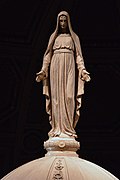 Statue of Virgin Mary on baldachin (2017)
 Basilica coat of arms in stained glass (2017)
 Choir pews located behind altar (2016)
 Stained glass windows (2006)
 Umbraculum, basilica exterior (2017)


See also
[edit]References
[edit]- 1 2 "National Register Information System". National Register of Historic Places. National Park Service. March 15, 2006.
- ↑ "Minneapolis landmarks and districts map". City of Minneapolis. February 13, 2025. Retrieved March 18, 2026.
- 1 2 3 "Basilica of Saint Mary | Minnesota Digital Library". mndigital.org. Retrieved 2025-01-29.
- ↑ "Basilica of St Mary Catholic Church - Archdiocese of Saint Paul and Minneapolis". www.archspm.org. Retrieved 2026-04-11.
- 1 2 3 Moynihan, James H.. The Life of Archbishop John Ireland. United States: Harper, 1953. pages 294-295
- ↑ "The Basilica | The Basilica of Saint Mary". www.mary.org. Archived from the original on 2017-11-29. Retrieved 2017-11-09.
- Nelson, Charles W. (1974-10-28). "National Register of Historic Places Inventory – Nomination Form: Basilica of Saint Mary". National Park Service. Retrieved 2015-04-15.
- ↑ "The Basilica of Saint Mary". Archdiocese of Saint Paul and Minneapolis. Archived from the original on 2011-04-26. Retrieved 2011-06-10.
- ↑ Ninth National Eucharistic Congress, St.Paul and Minneapolis, June 23-26, 1941: Official History and Record. Executive Committee of the Ninth National Eucharistic Congress. 1941.
- ↑ "Saint Paul and Minneapolis (Archdiocese) [Catholic-Hierarchy]". www.catholic-hierarchy.org. Retrieved 2026-04-11.
- ↑ Combs, Marianne (October 13, 2011). "Basilica of Saint Mary wins Partners in Preservation grant". Minnesota Public Radio. Retrieved 2012-01-19.
- ↑ Flynn, JD (May 31, 2020). "Amid riots, Basilica of St. Mary damaged by fire". The Catholic Spirit. Catholic News Agency. Retrieved December 5, 2024.
- ↑ "Senator Sticking Up for Catholics". www.churchmilitant.com. Archived from the original on August 21, 2020.
- ↑ "Pews Burned At Basilica Of St. Mary Amid Last Week's Riots". WCCO News. June 4, 2020.
- ↑ "Renovations underway at Basilica of St. Mary in downtown Minneapolis - CBS Minnesota". www.cbsnews.com. 2026-04-06. Retrieved 2026-04-13.
- ↑ Desaire, Mae (2023-02-13). "Homeless Jesus | The Basilica of Saint Mary". Retrieved 2026-04-13.
- ↑ Desaire, Mae (2023-02-16). "Our Lady of Guadalupe | The Basilica of Saint Mary". Retrieved 2026-04-12.
- ↑ Desaire, Mae (2023-02-13). "Our Lady of La'Vang | The Basilica of Saint Mary". Retrieved 2026-04-12.
- ↑ Desaire, Mae (2023-02-23). "Our Lady of the Immaculate Conception | The Basilica of Saint Mary". Retrieved 2026-04-12.
- ↑ Desaire, Mae (2023-02-17). "St. Anne, Mother of Mary | The Basilica of Saint Mary". Retrieved 2026-04-12.
- ↑ Desaire, Mae (2023-02-23). "Shrine of St. Anthony | The Basilica of Saint Mary". Retrieved 2026-04-12.
- ↑ Desaire, Mae (2023-02-23). "Shrine of St. Joseph | The Basilica of Saint Mary". Retrieved 2026-04-12.
- ↑ Desaire, Mae (2023-02-23). "Shrine of St. Thérèse of Lisieux | The Basilica of Saint Mary". Retrieved 2026-04-12.
- ↑ "Basilica Home". The Basilica of Saint Mary. Retrieved December 5, 2024.
- ↑ "Schola Cantorum". The Basilica of Saint Mary. 24 October 2022.
- ↑ "The Basilica Organ". The Basilica of Saint Mary. 13 February 2023. Retrieved December 5, 2024.
- ↑ "Saint Paul Chamber Orchestra: Basilica of Saint Mary". Retrieved February 21, 2018.
- ↑ Longworth, Nick (2025-02-12). "Basilica Block Party 'pauses' 2025 event as organizers consider options". FOX 9. Retrieved 2026-04-12.
- ↑ Halbach, Ashley (2025-02-12). "2025 Basilica Block Party canceled as church considers new options for 2026". KSTP.com 5 Eyewitness News. Retrieved 2026-04-12.
External links
[edit] Media related to Basilica of Saint Mary (Minneapolis) at Wikimedia Commons
- Official Basilica Site
- Roman Catholic Archdiocese of Saint Paul and Minneapolis Official Site
- History of the Basilica
- Basilica of St Mary, Minneapolis at "MNopedia", Minnesota Historical Society by R.L. Cartwright, 2012 (CC-By-SA).
- Basilica Block Party
- Basilica of Saint Mary Digital Collection, Minnesota Reflections


| International | |
|---|---|
| National | |
| Geographic | |

- Roman Catholic church buildings in Minneapolis
- Basilica churches in Minnesota
- Roman Catholic cathedrals in Minnesota
- National Register of Historic Places in Minneapolis
- Churches on the National Register of Historic Places in Minnesota
- Roman Catholic churches completed in 1907
- Beaux-Arts architecture in Minnesota
- Neoclassical architecture in Minnesota
- Church buildings with domes in the United States
- 1871 establishments in Minnesota
- 20th-century Roman Catholic church buildings in the United States
- Minor basilicas in the United States
- Churches in the Roman Catholic Archdiocese of Saint Paul and Minneapolis