


 | |||||||||||||||||
.jpg&mode=clean) Headquarters | |||||||||||||||||
| Type | Joint venture | ||||||||||||||||
|---|---|---|---|---|---|---|---|---|---|---|---|---|---|---|---|---|---|
| Industry | Automotive | ||||||||||||||||
| Founded | October 18, 2002 (2002-10-18) | ||||||||||||||||
| Headquarters | , China | ||||||||||||||||
Area served | China | ||||||||||||||||
| Products | Automobiles | ||||||||||||||||
| Owner | BAIC Motor (50%) Hyundai (50%) | ||||||||||||||||
Number of employees | 15,000[1] | ||||||||||||||||
| Chinese name | |||||||||||||||||
| Simplified Chinese | 北京现代汽车有限公司 | ||||||||||||||||
| Traditional Chinese | 北京現代汽車有限公司 | ||||||||||||||||
| |||||||||||||||||
| Beijing Hyundai | |||||||||||||||||
| Simplified Chinese | 北京现代 | ||||||||||||||||
| Traditional Chinese | 北京現代 | ||||||||||||||||
| |||||||||||||||||
| South Korean name | |||||||||||||||||
| Hangul | 북경현대 | ||||||||||||||||
| Hanja | 北京現代 | ||||||||||||||||
| |||||||||||||||||
| Website | www | ||||||||||||||||

Beijing Hyundai Motor Co., Ltd. is an automobile manufacturing company headquartered in Shunyi, Beijing, China, and a joint-venture between BAIC Motor and Hyundai Motor Company. Established in 2002, it manufactures in Shunyi District, a satellite city of Beijing,[2] producing Hyundai-branded automobiles for the Chinese market.
History
[edit source]In May 2002, Hyundai Motor and the Beijing Automotive Group signed a memorandum of understanding with the aim of creating a joint venture based around an existing Beijing factory. Hyundai begun to improve the plant's installations,[3] and on 18 October 2002 an equally owned joint venture between the two companies was established. While it was not the first arrangement between a foreign and a domestic automaker, Beijing Hyundai was the first to be approved by the Chinese government after its entry into the World Trade Organization.[4] The joint venture initially expanded its production output through importation of key parts from South Korea and the creation of an integrated, Korean-owned supply network inside China.[5][6] Beijing Hyundai's sedan sales in 2005 were 224,700 units, ranking fourth in the country. By 2010, Beijing Hyundai sales reached 700,000, and Hyundai Motor Group became the number 2 carmaker in China behind Volkswagen.
2014 saw the company sell 1,120,000 vehicles,[7] and in 2016, Hyundai reached its peak, selling 1.14 million vehicles.[8]
Decline
[edit source]
Following various issues, including the rise of Chinese car companies, marketing problems,[8] and the 2016-17 THAAD controversy, after which many South Korean businesses were boycotted by Chinese consumers,[9] Beijing Hyundai sales collapsed, dropping to just 248,839 by 2022, 240,792 in 2023, and 168,828 in 2024.[10][11]
After the collapse in sales, the company sold its first factory in Beijing in 2021 to Li Auto, and in 2024, it sold another factory in Chongqing for just $226 million, less than half its listing price.[8] Additionally, it lacks competitive NEV products despite it being half of Chinese car market share; in 2024, the only NEVs in the lineup were the imported Nexo hydrogen vehicle and Ioniq 5N.[12]
In November 2024, Hyundai announced that it was establishing an R&D center in Shanghai focused on developing ADAS and cockpit software solutions. Additionally, it announced plans to introduce a China-only EV model.[12]
Sales
[edit source]| Year | Sales |
|---|---|
| 2010 | 703,008[13] |
| 2011 | 739,800[14] |
| 2012 | 852,506[15] |
| 2013 | 1,029,222[16] |
| 2014 | 1,120,048[17] |
| 2015 | 1,058,553[18] |
| 2016 | 1,138,125[19] |
| 2017 | 755,659[20] |
| 2018 | 782,163[21] |
| 2019 | 685,126[22] |
| 2020 | 385,697[23] |
| 2021 | 361,395[24] |
| 2022 | 248,839 |
| 2023 | 240,792 |
| 2024 | 168,828[11] |
Products
[edit source]Current production
[edit source] | This section contains an excessive or unencyclopedic gallery of images. (August 2023) |
.jpg&mode=clean)
.jpg&mode=clean)

.jpg&mode=clean)
_China.jpg&mode=clean)
_China.jpg&mode=clean)
_China.jpg&mode=clean)
Former production
[edit source]


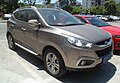
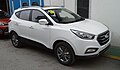
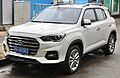


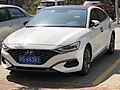


 2009–2017
Hyundai Moinca


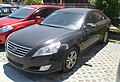


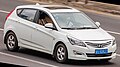
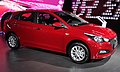
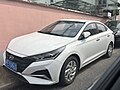
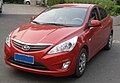


.jpg&mode=clean)


.jpg&mode=clean)
_China_(26).jpg&mode=clean)

).jpg&mode=clean)
_China.jpg&mode=clean)
_China_(7).jpg&mode=clean)


.jpg&mode=clean)
.jpg&mode=clean)
_China_(4).jpg&mode=clean)

.jpg&mode=clean)
.jpg&mode=clean)


)_China_(4).jpg&mode=clean)
_China_(3).jpg&mode=clean)


.jpg&mode=clean)
_China_(19).jpg&mode=clean)
_China_(15).jpg&mode=clean)
_China_(11).jpg&mode=clean)
_China_(22).jpg&mode=clean)
_China.jpg&mode=clean)
_front_view.jpg&mode=clean)


Current imported
[edit source]_China.jpg&mode=clean)

_(cropped).jpg&mode=clean)

_China.jpg&mode=clean)

_China_(5).jpg&mode=clean)
Former imported
[edit source]


_China_(3).jpg&mode=clean)
_China.jpg&mode=clean)


.jpg&mode=clean)
.jpg&mode=clean)

Production bases and facilities
[edit source]As of 2013, the company has at least three production bases[25] as well as an R&D center, all of which are probably in the Linhe Industrial Development Zone of the Shunyi District, a satellite city of Beijing.[26] Two of these produce automobiles and the other, engines.[26]
Its first automobile production base was completed in 2003 and the second in April 2008.[27] Construction on a third Beijing base begun in late 2010 should be complete in the second half of 2012.[28] At least one of these facilities is 17 km from Shunyi Yangzhen.[29]
A new site outside Beijing was inaugurated in 2016, and this Hebei location was producing a small city car, the Accent, as of 2017.[30]
In 2017, Beijing Hyundai opened its Chongqing plant, which produces the Reina subcompact sedan until 2021.[31]
See also
[edit source]References
[edit source]- ↑ "Brief Introduction" (in Chinese). Beijing Hyundai Motor. Archived from the original on 2009-05-22. Retrieved 2015-03-21.
- ↑ For ownership and company information, see BEIJING HYUNDAI OPENS NEW PLANT, ADDS NEW MODEL Hyundai Official Site, 2008-04-11
- For year established and production base location, see "Industrial tourism to Beijing Hyundai Auto Co. Ltd". Information Center of Shunyi District Government. 2011-09-15. Archived from the original on 2012-03-18. Retrieved 2012-05-26.
- ↑ Oh, Je-Wheon (2010). "Manufacturing Capability and Competitive Strategies of Beijing Hyundai in China". In Abō, Tetsuo (ed.). Competing Chinese and Foreign Firms in Swelling Chinese Economy: Competition Strategies for Japanese, Western and Asian Firms. Global Cultural and Economic Research. Vol. 5. LIT Verlag Münster. pp. 153–156. ISBN 978-3-8258-1740-4.
- ↑ "Beijing Hyundai Co., Ltd". Chinacsrmap.org. Archived from the original on March 4, 2016. Retrieved August 28, 2013.
- ↑ Thun, Eric (2006). "Global Integration and the Challenge of Upgrading". Changing Lanes in China: Foreign Direct Investment, Local Governments, and Auto Sector Development. Cambridge University Press. pp. 238–239. ISBN 978-0-521-84382-9.
- ↑ Doing Business in Beijing By China Knowledge Press Pte Ltd, Page 263 (2nd Ed., "2004 Edition"- 2005)
- ↑ "Hyundai Motor reveals goals for sales in China". Korean JoongAng Daily. JoongAng Ilbo. Jan 17, 2013. Retrieved 21 September 2013.
- 1 2 3 Jin, Qian (2024-01-17). "Beijing Hyundai sold Chongqing factory for 226 million USD, less than half of its initial listing price". CarNewsChina.com. Retrieved 2024-09-15.
- ↑ "China military criticizes 'wrong' U.S. moves on Taiwan, South China Sea". Reuters. August 17, 2017.
- ↑ "Hyundai. Car Sales in China". www.chinamobil.ru. Retrieved 2024-09-15.
- 1 2 "December, 2024 auto sales of Beijing Hyundai _in China - Gasgoo". autonews.gasgoo.com. Retrieved 2025-04-28.
- 1 2 Rainford, Mark (2024-11-02). "Hyundai To Launch China-only EV In 2025 As It Launches Local R&D Hub". Inside China Auto. Retrieved 2025-07-29.
- ↑ "December, 2010 sales of Beijing Hyundai - Gasgoo". autonews.gasgoo.com. Retrieved 2025-07-29.
- ↑ "December, 2011 sales of Beijing Hyundai - Gasgoo". autonews.gasgoo.com. Retrieved 2025-07-29.
- ↑ "December, 2012 sales of Beijing Hyundai - Gasgoo". autonews.gasgoo.com. Retrieved 2025-07-29.
- ↑ "December, 2013 sales of Beijing Hyundai - Gasgoo". autonews.gasgoo.com. Retrieved 2025-07-29.
- ↑ "December, 2014 sales of Beijing Hyundai - Gasgoo". autonews.gasgoo.com. Retrieved 2025-07-29.
- ↑ "December, 2015 sales of Beijing Hyundai - Gasgoo". autonews.gasgoo.com. Retrieved 2025-07-29.
- ↑ "December, 2016 sales of Beijing Hyundai - Gasgoo". autonews.gasgoo.com. Retrieved 2025-07-29.
- ↑ "December, 2017 sales of Beijing Hyundai - Gasgoo". autonews.gasgoo.com. Retrieved 2025-07-29.
- ↑ "December, 2018 sales of Beijing Hyundai - Gasgoo". autonews.gasgoo.com. Retrieved 2025-07-29.
- ↑ "December, 2019 sales of Beijing Hyundai - Gasgoo". autonews.gasgoo.com. Retrieved 2025-07-29.
- ↑ "December, 2020 sales of Beijing Hyundai - Gasgoo". autonews.gasgoo.com. Retrieved 2025-07-29.
- ↑ "December, 2021 auto sales of Beijing Hyundai _in China - Gasgoo". autonews.gasgoo.com. Retrieved 2025-07-29.
- ↑ "Hyundai Motor Unveils China-Exclusive Elantra at the 2012 Beijing Motor Show". Hyundai Motor Company. 2012-04-23. Archived from the original on 2013-09-27. Retrieved January 16, 2013.
- 1 2 Industrial tourism to Beijing Hyundai Auto Co. Ltd Archived 2012-03-18 at the Wayback Machine Press Release, Information Center of Shunyi District Government, 2009-4-12
- ↑ For first production base, see Beijing Auto Manufacturing Base Archived 2010-07-04 at the Wayback Machine Press Release, Information Center of Shunyi District Government, 2009-4-10
- For second production base, see BEIJING HYUNDAI OPENS NEW PLANT, ADDS NEW MODEL Hyundai Official Site, 2008-04-11
- ↑ "Short Torque: Hyundai's third facility", China Daily: 19, 2010-12-06
- ↑ Part Overview Archived 2011-04-30 at the Wayback Machine Beijing Hainachuan Automotive Parts Co., Ltd.
- ↑ Jin, Hyunwoo (27 March 2017). "Hyundai suspends China plant for a week amid diplomatic stand-off". reuters.com. Thomson Reuters.
- ↑ Lee, Seung-hoon (2017-09-20). "Hyundai Motor rolls out All New Reina from new Chinese factory Amid woes in China". Maeil Business Newspaper. Retrieved 2019-01-30.
External links
[edit source]- Beijing Hyundai Motor Official Site (in Chinese)
- Genesis Motor China Official Site (in Chinese and English)
- Hyundai Motor China Import Official Site (in Chinese)
- Picture of a Beijing Hyundai building
| Marques | |||||
|---|---|---|---|---|---|
| Subsidiaries | |||||
| Joint ventures and shareholdings |
| ||||
| Vehicles | |||||
| |||||

See also: Hyundai Commercial Vehicles | |||||||||
| Marques | |||||||||
| Subsidiaries, divisions, and factories |
| ||||||||
| Affiliates |
| ||||||||
| Current models |
| ||||||||
| Discontinued models |
| ||||||||
| Upcoming cars | |||||||||
| Concept cars |
| ||||||||
| Platforms | |||||||||
| Others | |||||||||
