


| Clitoria ternatea | |
|---|---|
 | |
| Flower and foliage | |
Scientific classification  | |
| Kingdom: | Plantae |
| Clade: | Embryophytes |
| Clade: | Tracheophytes |
| Clade: | Spermatophytes |
| Clade: | Angiosperms |
| Clade: | Eudicots |
| Clade: | Rosids |
| Order: | Fabales |
| Family: | Fabaceae |
| Subfamily: | Faboideae |
| Genus: | Clitoria |
| Species: | C. ternatea |
| Binomial name | |
| Clitoria ternatea | |
Clitoria ternatea, commonly known as Shankhupushpam (conch-shaped flower), Asian pigeonwings,[1] bluebellvine, blue pea, butterfly pea, cordofan pea, or Darwin pea,[2] is a plant species belonging to the family Fabaceae and native to the Indonesian island of Ternate.[3]: 215 In Indian Ayurveda it is commonly known by the name aparajita.[4][5]
Description
[edit]It is a perennial herbaceous plant, with elliptic, obtuse leaves. It grows as a vine or creeper, doing well in moist, neutral soil. Its most striking feature is the color of its flowers, a vivid deep blue; solitary, with light yellow markings. They are about 4 cm (1+1⁄2 in) long by 3 cm (1+1⁄4 in) wide. Some varieties yield white flowers and pink.
The fruits are 5–7 cm (2–2+3⁄4 in) long, flat pods with six to ten seeds in each pod.
It is grown as an ornamental plant and as a revegetation species (e.g., in coal mines in Australia), requiring little care when cultivated. As a legume, its roots form a symbiotic association with soil bacteria known as rhizobia, which transform atmospheric N2 into a plant-usable form (a process called nitrogen fixation), therefore, this plant is also used to improve soil quality through the decomposition of nitrogen rich plant material.
Chemistry
[edit]Chemical compounds isolated from C. ternatea include various triterpenoids, flavonol glycosides, anthocyanins and steroids.[6] Cyclic peptides known as cliotides have been isolated from the heat-stable fraction of C. ternatea extract.[7] The blue colour of C. ternatea is a result of various anthocyanins, most importantly ternatins – polyacylated derivatives of delphinidin 3,3', 5'-triglucoside (Da-T).[8][9][10]
_in_West_Bengal%2C_India.jpg&mode=clean)
.jpg&mode=clean)

Etymology
[edit]The genus name Clitoria is derived from "clitoris", due to their blossoms' shape that resembles the shape of a human vulva. The first reference to the genus, which includes an illustration of the plant, was made in 1678 by Jakób Breyne, a Polish naturalist, who described it as Flos clitoridis ternatensibus, meaning 'Ternatean flower of the clitoris'.[11][12] The species name is derived from the name of the island where botanist Carl Linnaeus's specimens originated: the Ternate Island, located in the northern part of the Maluku Islands.[13][3]
Distribution
[edit]This plant is native to equatorial Asia, including locations in South Asia and Southeast Asia but has also been introduced to Africa, Australia and the Americas.
Cultivation
[edit]C. ternatea does not suffer from any severe pest or disease problems.[14][15]
Pests
[edit]Rarely suffers from caterpillars,[14] whiteflies,[14][15][16] and spider mites.[15][16]
Diseases
[edit]Suffers from anthracnose and bacterial soft rot.[16] Rarely suffers from fungal root rots.[15]
Uses
[edit]The flower can be used to dye natural fibers and is used by traditional societies in Asia to do so.
Culinary
[edit]In Southeast Asia, the flower is used as a natural food colouring to colour glutinous rice and desserts like the Eurasian putugal as well as an ayurvedic medicine.[17] In Kelantan, in the north-east of peninsular Malaysia, it is an important ingredient in nasi kerabu, giving it its characteristic bluish colour. It is also used to colour the Nyonya dish pulot tartal.[18]
The seeds/pods are edible when tender.[citation needed]
Butterfly pea flower tea is made from the ternatea flowers and dried lemongrass and changes color depending on what is added to the liquid, with lemon juice turning it purple.[19] In Thailand and Vietnam, this butterfly blue pea flower tea is commonly mixed with honey and lemon to increase acidity and turn the beverage a pink-purple color, to produce for a drink usually served after dinner, or as a refreshment at hotels and spas.[20] The drink is a typical local drink like chamomile tea is in other parts of the world.[20] The tea is found in both hot and cold varieties.[21]
The flowers have more recently been used in a color-changing gin and absinthe. Blue in the bottle, it turns pink when mixed with a carbonated mixer such as tonic water due to the change in pH.[22] As organic colours are not permanent, this type of gin is recommended to be stored in a dark place to maintain the effect.[23] It is, however, not an allowed food ingredient in the EU and at least one gin using it was recalled for that reason.[24]
This plant has a long use in traditional Ayurveda.[6][25][26] No clinical trials on humans have been conducted.[26]
Insecticidal activity
[edit]Clitoria ternatea produces a class of cyclic peptides known as cyclotides, which exhibit potent insecticidal properties. These naturally occurring compounds are characterized by a stable cyclic cystine knot motif [27] contributing to their resistance to enzymatic degradation and their bioactivity against insect pests. This activity has been utilized in the formulation of botanical insecticides based on plant-derived extracts.[28] Extracts of C. ternatea have been commercialized for pest control and have been officially recognized as an active substance with a classification by the Insecticide Resistance Action Committee (IRAC).[29] The insecticidal mode of action of cyclotides is believed to involve disruption of the epithelial membranes in the midgut of insect larvae following ingestion, leading to cell lysis and death.[30] In addition to its toxic effects, Ct-extract has demonstrated repellent activity, contributing to pest management by deterring insect feeding and oviposition.[31]
Gallery
[edit]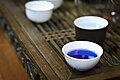 Butterfly pea flower tea is made from C ternatea flowers
 Thai khao tom sweet, colored blue with C. ternatea flowers
 A less common "double-flowered" C. ternatea
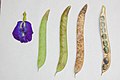 Flower and pods in different states of ripeness
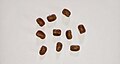 Seeds
Seeds Vietnamese woman collecting butterfly pea flowers in her nón lá


.JPG&mode=clean)

.jpg&mode=clean)

References
[edit]- ↑ NRCS. "Clitoria ternatea". PLANTS Database. United States Department of Agriculture (USDA). Retrieved 31 Jul 2016.
- ↑ "Clitoria ternatea L." Germplasm Resources Information Network. Agricultural Research Service, United States Department of Agriculture. Retrieved 31 Jul 2016.
- 1 2 Don, George (1831). A General History of the Dichleamydeous Plants. J. G. and F. Rivington.
C. Ternatea being a native to the island of Ternate
- ↑ "Aparajita". ayurwiki.
- ↑ "Ayurvedic name" (PDF). International Journal of Pharmacy and Biological Sciences.
- 1 2 Mukherjee PK, Kumar V, Kumar NS, Heinrich M (2008). "The Ayurvedic medicine Clitoria ternatea-From traditional use to scientific assessment". J Ethnopharmacol. 120 (3): 291–301. doi:10.1016/j.jep.2008.09.009. PMID 18926895.
- ↑ Nguyen, GK; Zhang, S; Nguyen, NT; Nguyen, PQ; Chiu, MS; Hardjojo, A; Tam, JP. (Jul 2011). "Discovery and characterization of novel cyclotides originated from chimeric precursors consisting of albumin-1 chain a and cyclotide domains in the Fabaceae family". J Biol Chem. 286 (27): 24275–87. doi:10.1074/jbc.m111.229922. PMC 3129208. PMID 21596752.
- ↑ Terahara, Norihiko; Saito, Norio; Honda, Toshio; Toki, Kenjiro; Osajima, Yutaka (1990-01-01). "Acylated anthocyanins of Clitoria ternatea flowers and their acyl moieties". Phytochemistry. 29 (3): 949–953. Bibcode:1990PChem..29..949T. doi:10.1016/0031-9422(90)80053-J. ISSN 0031-9422.
- ↑ Terahara, Norihiko; Oda, Masahiro; Matsui, Toshiro; Osajima, Yutaka; Saito, Norio; Toki, Kenjiro; Honda, Toshio (1996-01-01). "Five New Anthocyanins, Ternatins A3, B4, B3, B2, and D2, from Clitoria ternatea Flowers". Journal of Natural Products. 59 (2): 139–144. Bibcode:1996JNAtP..59..139T. doi:10.1021/np960050a. ISSN 0163-3864. PMID 8991946.
- Fantz, Paul R. (2000). "Nomenclatural Notes on the Genus Clitoria for the Flora North American Project". Castanea. 65 (2): 89–92. JSTOR 4034108.
- ↑ Breyne, Jakób (1678). Exoticarum aliarumque minus cognitarum plantarum centuria prima [Exotic and other less-known plants of the first century] (in Latin). Biblioteca Digital del Real Jardin Botanico de Madrid: David-Fridericus Rhetius.
- ↑ Oguis, Georgianna K.; Gilding, Edward K.; Jackson, Mark A.; Craik, David J. (28 May 2019). "Butterfly Pea (Clitoria ternatea), a Cyclotide-Bearing Plant with Applications in Agriculture and Medicine". Frontiers in Plant Science. 10: 645. Bibcode:2019FrPS...10..645O. doi:10.3389/fpls.2019.00645. PMC 6546959. PMID 31191573.
- 1 2 3 "Clitoria ternatea (Pale Blue)". NParks Singapore. 2021-08-19. Archived from the original on 2021-01-28. Retrieved 2022-05-01.
- 1 2 3 4 Blackstone, Victoria Lee (2012-12-06). "How to Make Blue Pea Vines Bloom". SF Gate. Retrieved 2022-05-01.
- 1 2 3 "Clitoria ternatea". Plant Finder. Missouri Botanical Garden. Retrieved 2022-05-01.
- ↑ Vuong, Tung Thanh; Hongsprabhas, Parichat (2021-01-01). Yildiz, Fatih (ed.). "Influences of pH on binding mechanisms of anthocyanins from butterfly pea flower (Clitoria ternatea) with whey powder and whey protein isolate". Cogent Food & Agriculture. 7 (1) 1889098. Bibcode:2021CogFA...789098V. doi:10.1080/23311932.2021.1889098. S2CID 233972591.
- ↑ "Pulut Tai Tai". nyonyacooking.com. Nyonyacooking. 14 March 2015. Retrieved 14 November 2021.
1 tbsp butterfly pea flowers (dried
- ↑ Pantazi, Chloe (February 26, 2016). "Watch this tea dramatically change from deep blue to vibrant red with a squeeze of lemon". Business Insider Deutschland. Archived from the original on September 30, 2018. Retrieved July 2, 2016.
- 1 2 Goldberg, Elyssa (January 31, 2016). "The Science Behind This Mesmerizing Color-Changing Tea". Bon Appétit. Retrieved July 2, 2016.
- ↑ Reid, Marian (October 16, 2012). "Be good to yourself in Chiang Mai". BBC Travel. the British Broadcasting Corporation. Retrieved July 3, 2016.
- ↑ "This magical gin changes colour when tonic's added to it". Good Housekeeping.
- ↑ "Road test: Ink gin changes colour when mixed with tonic". The Australian. 13 May 2016. Retrieved 2018-12-18.
- ↑ "Recall: Maister gin".
- ↑ Fantz, Paul R. (1991). "Ethnobotany of Clitoria (Leguminosae)". Economic Botany. 45 (4). New York Botanical Garden Press: 511–20. Bibcode:1991EcBot..45..511F. doi:10.1007/BF02930715. JSTOR 4255394. S2CID 38939748.
- 1 2 Mukherjee PK, Kumar V, Kumar NS, Heinrich M (December 2008). "The Ayurvedic medicine Clitoria ternatea--from traditional use to scientific assessment". J Ethnopharmacol (Review). 120 (3): 291–301. doi:10.1016/j.jep.2008.09.009. PMID 18926895.
- ↑ Rosengren, K. Johan; Daly, Norelle L.; Plan, Manuel R.; Waine, Clement; Craik, David J. (2003-03-07). "Twists, Knots, and Rings in Proteins: STRUCTURAL DEFINITION OF THE CYCLOTIDE FRAMEWORK *". Journal of Biological Chemistry. 278 (10): 8606–8616. doi:10.1074/jbc.M211147200. ISSN 0021-9258. PMID 12482868.
- ↑ "SERO-X". Bi-PA. Retrieved 2025-06-23.
- ↑ "Mode of Action Classification | Insecticide Resistance Management | IRAC". Insecticide Resistance Action Committee. Retrieved 2025-06-23.
- ↑ Barbeta, Barbara L.; Marshall, Alan T.; Gillon, Amanda D.; Craik, David J.; Anderson, Marilyn A. (2008-01-29). "Plant cyclotides disrupt epithelial cells in the midgut of lepidopteran larvae". Proceedings of the National Academy of Sciences. 105 (4): 1221–1225. Bibcode:2008PNAS..105.1221B. doi:10.1073/pnas.0710338104. ISSN 0027-8424. PMC 2234119. PMID 18202177.
- ↑ Oguis, Georgianna K.; Gilding, Edward K.; Jackson, Mark A.; Craik, David J. (2019-05-28). "Butterfly Pea (Clitoria ternatea), a Cyclotide-Bearing Plant With Applications in Agriculture and Medicine". Frontiers in Plant Science. 10. Bibcode:2019FrPS...10..645O. doi:10.3389/fpls.2019.00645. ISSN 1664-462X. PMC 6546959. PMID 31191573.
External links
[edit] Media related to Clitoria ternatea at Wikimedia Commons
- "Plant of the Week—Clitoria ternatea". Archived from the original on 2007-08-09. Retrieved 2007-07-31.
- "Clitoria ternatea". Tropical Forages. Archived from the original on 2007-08-17. Retrieved 2007-07-31.
- A strain of Clitoria ternatea from the Philippines from the Int'l Soc. for Taxonomic Explorations Archived 2020-10-24 at the Wayback Machine by Isidro A. T. Savillo.