


_bombarding_Japanese_defenses_on_Iwo_Jima%2C_16_February_1945_(80-G-308952).jpg&mode=clean)
The Pacific Ocean theater of World War II was a major theater of war between the Allied powers and the Empire of Japan during World War II.[1] It was one of four theaters within the overall Pacific War, the largest theater of World War II. The other three theaters were the South West Pacific theater, the Second Sino-Japanese War, and the brief Soviet–Japanese War. The term "Pacific Theater" can refer to the overall Pacific War or the Pacific Ocean theater, depending on context.
Commands
[edit]Allied
[edit]
On March 30, 1942, US Admiral Chester Nimitz was appointed Commander-in-Chief, Pacific Ocean Areas. In the other major theater in the Pacific region, known as the South West Pacific theater, Allied forces were commanded by US General Douglas MacArthur. Both Nimitz and MacArthur were overseen by the US Joint Chiefs, and indirectly by the British-American Combined Chiefs of Staff.
In the Pacific Ocean theater, Japanese forces fought primarily against the United States Navy, the U.S. Army, which had 6 Corps and 21 Divisions, and the U.S. Marine Corps, which had only 6 Divisions. The United Kingdom (British Pacific Fleet), New Zealand, Australia, Canada, and other Allied nations, also contributed forces.
Japanese
[edit]Most Japanese forces in the theater were part of the Combined Fleet (連合艦隊, Rengō Kantai) of the Imperial Japanese Navy (IJN), which was responsible for all Japanese warships, naval aircraft, and marine infantry units. The Rengō Kantai was led by Admiral Isoroku Yamamoto, until he was killed in an attack by U.S. fighter planes in April 1943.[2] Yamamoto was succeeded by Admiral Mineichi Koga (1943–44)[2] and Admiral Soemu Toyoda (1944–45).[3] The General Staff (参謀本部, Sanbō Honbu) of the Imperial Japanese Army (IJA) was responsible for Imperial Japanese Army ground and air units in Southeast Asia and the South Pacific. The IJN and IJA did not formally use joint/combined staff at the operational level, and their command structures/geographical areas of operations overlapped with each other and those of the Allies.
Campaigns and battles
[edit]
|
  Pearl Harbor-1941J Wake Island-1941J Bataan-1942J Corregidor-1942J Ambon-1942J Rabaul-1942J Java Sea-1942J Coral Sea-1942 Battle of Darwin-1942J Savo-1942J Guadalcanal-1942A Midway-1942A Solomons-1942-1945/A Bismarck Sea-1943A Makin-1943A Eniwetok-1944A Kwajalein-1944A Tarawa-1943A Truk-1944A Saipan-1944A Philippine Sea-1944A Guam-1944A Tinian-1944A Peleliu-1944A Anguar-1944A Leyte-1944A Timor-1942J Luzon-1945A Iwo Jima-1945A Okinawa-1945A Hiroshima Nagasaki New Guinea 1942–1945A
|
Gallery
[edit]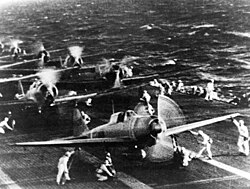 Japanese naval aircraft prepare to take off from an aircraft carrier.
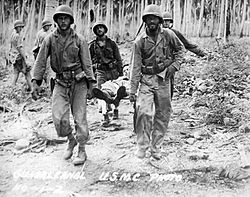 U.S. 5th Marines evacuate injured personnel during actions on Guadalcanal on November 1, 1942.
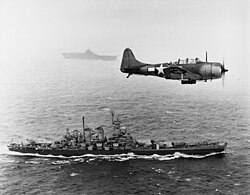 An SBD Dauntless flies patrol over USS Washington and USS Lexington during the Gilbert and Marshall Islands campaign, November 12, 1943.


Notes
[edit]- ↑ "Pacific War". American Heritage Museum. Retrieved July 3, 2026.
- 1 2 Potter & Nimitz 1960, p. 717.
- ↑ Potter & Nimitz 1960, pp. 759–60.
References
[edit]- Cressman, Robert J. (2000), The Official Chronology of the U.S. Navy in World War II, Annapolis, MD: Naval Institute Press, ISBN 1-55750-149-1.
- Drea, Edward J. (1998), In the Service of the Emperor: Essays on the Imperial Japanese Army, NB: University of Nebraska Press, ISBN 0-8032-1708-0.
- Hakim, Joy (1995), A History of Us: War, Peace and All That Jazz, New York: Oxford University Press, ISBN 0-19-509514-6.
- Kafka, Roger; Pepperburg, Roy L. (1946), Warships of the World, New York: Cornell Maritime Press.
- Miller, Edward S. (2007), War Plan Orange: The U.S. Strategy to Defeat Japan, 1897–1945, US Naval Institute Press, ISBN 978-1-59114-500-4.
- Ofstie, Ralph A. (1946). The Campaigns of the Pacific War. Washington, DC: United States Government Printing Office..
- Potter, E. B.; Nimitz, Chester W. (1960), Sea Power, Prentice-Hal.
- Silverstone, Paul H. (1968), U.S. Warships of World War II, Doubleday & Co.
- Toll, Ian W. (2011). Pacific Crucible: War at Sea in the Pacific, 1941–1942. New York: W. W. Norton.
- ——— (2015). The Conquering Tide: War in the Pacific Islands, 1942–1944. New York: W. W. Norton.
- ——— (2020). Twilight of the Gods: War in the Western Pacific, 1944–1945. New York: W. W. Norton.

| National | |
|---|---|
| Other | |
