


Particle methods is a widely used class of numerical algorithms in scientific computing. Its application ranges from computational fluid dynamics (CFD) over molecular dynamics (MD) to discrete element methods.
History
[edit]One of the earliest particle methods is smoothed particle hydrodynamics, presented in 1977.[1] Libersky et al.[2] were the first to apply SPH in solid mechanics. The main drawbacks of SPH are inaccurate results near boundaries and tension instability that was first investigated by Swegle.[3]
In the 1990s a new class of particle methods emerged. The reproducing kernel particle method[4] (RKPM) emerged, the approximation motivated in part to correct the kernel estimate in SPH: to give accuracy near boundaries, in non-uniform discretizations, and higher-order accuracy in general. Notably, in a parallel development, the Material point methods were developed around the same time[5] which offer similar capabilities. During the 1990s and thereafter several other varieties were developed including those listed below.
List of methods and acronyms
[edit]The following numerical methods are generally considered to fall within the general class of "particle" methods. Acronyms are provided in parentheses.
- Smoothed particle hydrodynamics (SPH) (1977)
- Dissipative particle dynamics (DPD) (1992)
- Reproducing kernel particle method (RKPM) (1995)
- Moving particle semi-implicit (MPS)
- Particle-in-cell (PIC)
- Moving particle finite element method (MPFEM)
- Cracking particles method (CPM) (2004)
- Immersed particle method (IPM) (2006)
Definition
[edit]The mathematical definition of particle methods captures the structural commonalities of all particle methods.[6] It, therefore, allows for formal reasoning across application domains. The definition is structured into three parts: First, the particle method algorithm structure, including structural components, namely data structures, and functions. Second, the definition of a particle method instance. A particle method instance describes a specific problem or setting, which can be solved or simulated using the particle method algorithm. Third, the definition of the particle state transition function. The state transition function describes how a particle method proceeds from the instance to the final state using the data structures and functions from the particle method algorithm.[6]
A particle method algorithm is a 7-tuple , consisting of the two data structures
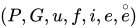

such that is the state space of the particle method, and five functions:
![{\displaystyle [G\times P^{*}]}](https://wikimedia.org/api/rest_v1/media/math/render/svg/23bef26dc0c24bd88afdb07866ae0d3e7898bc51)
![{\displaystyle {\begin{aligned}&u:[G\times P^{*}]\times \mathbb {N} \rightarrow \mathbb {N} ^{*}&&{\text{the neighborhood function,}}\\&f:G\rightarrow \{\top ,\bot \}&&{\text{the stopping condition,}}\\&i:G\times P\times P\rightarrow P\times P&&{\text{the interact function,}}\\&e:G\times P\rightarrow G\times P^{*}\ &&{\text{the evolve function,}}\\&{\overset {\circ }{e}}:G\rightarrow G&&{\text{the evolve function of the global variable.}}\end{aligned}}}](https://wikimedia.org/api/rest_v1/media/math/render/svg/0f3d891b0cfcde5e4a0c6e0b350e9831b35279c3)
An initial state defines a particle method instance for a given particle method algorithm :
![{\displaystyle [g^{1},\mathbf {p} ^{1}]\in [G\times P^{*}].}](https://wikimedia.org/api/rest_v1/media/math/render/svg/3d39e87b8e60e5bf0b4859702100207dce0005e7)
The instance consists of an initial value for the global variable and an initial tuple of particles .


In a specific particle method, the elements of the tuple need to be specified. Given a specific starting point defined by an instance , the algorithm proceeds in iterations. Each iteration corresponds to one state transition step that advances the current state of the particle method to the next state . The state transition uses the functions to determine the next state. The state transition function generates a series of state transition steps until the stopping function is . The so-calculated final state is the result of the state transition function. The state transition function is identical for every particle method.
![{\displaystyle [g^{1},\mathbf {p} ^{1}]}](https://wikimedia.org/api/rest_v1/media/math/render/svg/3a6e76d1347069eedb0f89e0a4ba84e44a6f0d28)

![{\displaystyle [g^{t},\mathbf {p} ^{t}]}](https://wikimedia.org/api/rest_v1/media/math/render/svg/fc4686ceb0ca1f0ad68e6ae0815c88322d644b10)
![{\displaystyle [g^{t+1},\mathbf {p} ^{t+1}]}](https://wikimedia.org/api/rest_v1/media/math/render/svg/586d51da19026536d7cebd4e1e6f1088ecd814c8)


The state transition function is defined as
![{\displaystyle S:[G\times P^{*}]\rightarrow [G\times P^{*}]}](https://wikimedia.org/api/rest_v1/media/math/render/svg/d7c8d502c913649a49cde52447d50e3ed5f02def)
with
.
![{\displaystyle [g^{T},\mathbf {p} ^{T}]:=S([g^{1},\mathbf {p} ^{1}])}](https://wikimedia.org/api/rest_v1/media/math/render/svg/b4b862268056ae291166d6d0a485a79c9e41edeb)
The pseudo-code illustrates the particle method state transition function:
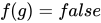
1 2 while 3 for to 4 5 for to 6 7 8 for to 9 10 11 12 13
![{\displaystyle [g,\mathbf {p} ]=[g^{1},\mathbf {p} ^{1}]}](https://wikimedia.org/api/rest_v1/media/math/render/svg/ce6b0539481596f1b4522e2eb8d35f755edd903a)


![{\displaystyle \mathbf {k} =u([g,\mathbf {p} ],j)}](https://wikimedia.org/api/rest_v1/media/math/render/svg/d5bbd6619394c9f2d3dbb594c360fed07a2b90a1)







![{\displaystyle [g^{T},\mathbf {p} ^{T}]=[g,\mathbf {p} ]}](https://wikimedia.org/api/rest_v1/media/math/render/svg/11fd7444e11ab7e622e1c655e1df89820ae46c2f)
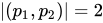
The fat symbols are tuples, are particle tuples and is an index tuple. is the empty tuple. The operator is the concatenation of the particle tuples, e.g. . And is the number of elements in the tuple , e.g. .




See also
[edit]References
[edit]- ^ Gingold RA, Monaghan JJ (1977). Smoothed particle hydrodynamics – theory and application to non-spherical stars. Mon Not R Astron Soc 181:375–389
- ^ Libersky, L.D., Petscheck, A.G., Carney, T.C., Hipp, J.R., Allahdadi, F.A. (1993). High Strain Lagrangian Hydrodynamics. Journal of Computational Physics.
- ^ Swegle, J.W., Hicks, D.L., Attaway, S.W. (1995). Smoothed Particle Hydrodynamics Stability Analysis. Journal of Computational Physics. 116(1), 123-134
- ^ Liu, W.K., Jun, S., Zhang, Y.F. (1995), Reproducing kernel particle methods, International Journal of Numerical Methods in Fluids. 20, 1081-1106.
- ^ D. Sulsky, Z., Chen, H. Schreyer (1994). a Particle Method for History-Dependent Materials. Computer Methods in Applied Mechanics and Engineering (118) 1, 179-196.
- ^ a b Pahlke, Johannes; Sbalzarini, Ivo F. (March 2023). "A Unifying Mathematical Definition of Particle Methods". IEEE Open Journal of the Computer Society. 4: 97–108. doi:10.1109/OJCS.2023.3254466. S2CID 257480034.
 This article incorporates text available under the CC BY 4.0 license.
- Liu MB, Liu GR, Zong Z, AN OVERVIEW ON SMOOTHED PARTICLE HYDRODYNAMICS, INTERNATIONAL JOURNAL OF COMPUTATIONAL METHODS Vol. 5 Issue: 1, 135–188, 2008.
- Liu, G.R., Liu, M.B. (2003). Smoothed Particle Hydrodynamics, a meshfree and Particle Method, World Scientific, ISBN 981-238-456-1.