


.jpg&mode=clean)


A road train, also known as a land train or long combination vehicle (LCV), is a semi-trailer truck used to move road freight more efficiently than single-trailer semi-trailers. It consists of two semi-trailers or more connected together with or without a prime mover.[1] It typically has to be at least two trailers and one prime mover. Road trains are often used in areas where other forms of heavy transport (freight train, cargo aircraft, container ship) are not feasible or practical.
History
[edit]Early road trains consisted of traction engines pulling multiple wagons. The first identified road trains operated into South Australia's Flinders Ranges from the Port Augusta area in the mid-19th century.[2] They displaced bullock teams for the carriage of minerals to port and were, in turn, superseded by railways.
During the Crimean War, a traction engine was used to pull multiple open trucks.[3] By 1898 steam traction engine trains with up to four wagons were employed in military manoeuvres in England.[4]
In 1900, John Fowler & Company provided armoured road trains for use by the British Armed Forces in the Second Boer War.[3][5] Lord Kitchener stated that he had around 45 steam road trains at his disposal.[6]
A road train devised by Captain Charles Renard of the French Engineering Corps was displayed at the 1903 Paris Salon. After his death, Daimler, which had acquired the rights, attempted to market it in the United Kingdom.[7][8] Four of these vehicles were successfully delivered to Queensland, Australia, before the company ceased production upon the start of World War I.[9]
In the 1930s/40s, the government of Australia operated an AEC Roadtrain to transport freight and supplies into the Northern Territory, replacing the Afghan camel trains that had been trekking through the deserts since the late 19th century. This truck pulled two or three 6 m (19 ft 8 in) Dyson four-axle self-tracking trailers. At 130 hp (97 kW), the AEC was grossly underpowered by today's standards, and drivers and offsiders (a partner or assistant) routinely froze in winter and sweltered in summer due to the truck's open cab design and the position of the engine radiator, with its 1.5 m (4 ft 11 in) cooling fan, behind the seats.

Australian Kurt Johannsen, a bush mechanic, is recognised as the inventor of the modern road train.[10] After transporting stud bulls 200 mi (320 km) to an outback property, Johannsen was challenged to build a truck to carry 100 head of cattle instead of the original load of 20. Provided with financing of about 2000 pounds and inspired by the tracking abilities of the Government roadtrain, Johannsen began construction. Two years later his first road train was running.[11]
Johannsen's first road train consisted of a United States Army World War II surplus Diamond-T tank carrier, nicknamed "Bertha", and two home-built self-tracking trailers. Both wheel sets on each trailer could steer, and therefore could negotiate the tight and narrow tracks and creek crossings that existed throughout Central Australia in the earlier part of the 20th century. Freighter Trailers in Australia viewed this improved invention and went on to build self-tracking trailers for Kurt and other customers, and went on to become innovators in transport machinery for Australia.[citation needed]
This first example of the modern road train, along with the AEC Government Roadtrain, forms part of the collection at the National Road Transport Museum in Alice Springs.[12]
In 2023, Janus launched the first battery electric (BEV) triple road train with 620 kWh battery, also the world's heaviest street-legal BEV truck at 170 tonnes (gross weight).[13]
Usage
[edit]Australia
[edit]
The term road train is used in Australia and typically means a prime mover hauling two or more trailers, other than a B-double.[14] In contrast with a more common semi-trailer towing one trailer or semi-trailer, the diesel prime mover of a road train hauls two or more trailers or semi-trailers. Australia has the longest and heaviest road-legal road trains in the world, weighing up to 200 tonnes (197 long tons; 220 short tons).[1]


Double (two-trailer) road train combinations are allowed on some roads in most states of Australia, including specified approaches to the ports and industrial areas of Adelaide, South Australia[15] and Perth, Western Australia.[16] An A-double road train should not be confused with a B-double, which is allowed access to most of the country and in all major cities.[17]
In South Australia, B-triples up to 35.0 metres (114 ft 10 in) and two-trailer road trains to 36.5 metres (119 ft 9 in) are permitted on only a small number of approved routes in the north and west of the state, including access to Adelaide's north-western suburban industrial and export areas such as Port Adelaide, Gillman and Outer Harbour via Salisbury Highway, Port Wakefield Road and Augusta Highway before 2017.[15] A project named Improving Road Transport for the Agriculture Industry added 7,200 kilometres (4,500 mi) of key routes on which it is permitted to operate vehicles over 30 m (98 ft 5 in) in 2015–2018.[18]

Triple (three-trailer) road trains operate in western New South Wales, western Queensland, South Australia, Western Australia, and the Northern Territory, with the last three states also allowing AB-quads (a B double with two additional trailers coupled behind). Darwin is the only capital city in the world where triples and quads are allowed to within 1 km (0.62 mi) of the central business district (CBD).[17]
Strict regulations regarding licensing, registration, weights, and experience apply to all operators of road trains throughout Australia.
Road trains are used for transporting all manner of materials; common examples are livestock, fuel, mineral ores, and general freight. Their cost-effective transport has played a significant part in the economic development of remote areas; some communities are totally reliant on regular service.
.jpg&mode=clean)
When road trains get close to populated areas, the multiple dog-trailers are unhooked, the dollies removed and then connected individually to multiple trucks at "assembly" yards.
When the flat-top trailers of a road train need to be transported empty, it is common practice to stack them. This is commonly referred to as "doubled-up" or "doubling-up". If many trailers must be moved at one time, they are sometimes triple-stacked, or "tripled-up".
Higher Mass Limits (HML) Schemes are now extant in all jurisdictions in Australia, allowing trucks to carry additional weight beyond general mass limits. Some roads in some states regularly allowing up to 4 trailers at 53.5 metres (175 ft 6 in) long and 136 tonnes (134 long tons; 150 short tons).[19] On private property such as mines, highway restrictions on trailer length, weight, and count may not apply. Some of the heaviest road trains carrying ore are multiple unit with a diesel engine in each trailer, controlled by the tractor.[20][21]
Diesel sales in Australia (per year) are around 32 billion litres,[22] of which some is used by road trains. In order to reduce emissions and running cost, trials are made with road trains powered by batteries.[23][24]
United States
[edit]
In most of the United States, trucks on public roads are limited to two trailers (two 28 ft or 8.5 m and a dolly to connect; the limit is 63 ft or 19 m end to end). Some states allow three 28 ft or 8.5 m trailers, although triples are usually restricted to less populous states such as Idaho, Oregon, and Montana, plus the Ohio Turnpike[25] and the Indiana East–West Toll Road. Triples are used for long-distance less-than-truckload freight hauling (in which case the trailers are shorter than a typical single-unit trailer) or resource hauling in the interior west (such as ore or aggregate). Triples are sometimes marked with "LONG LOAD" banners both front and rear. "Turnpike doubles"—tractors towing two full-length trailers—are allowed on the New York Thruway and Massachusetts Turnpike (Interstate 90), Florida's Turnpike, Kansas Turnpike (Kansas City – Wichita route) as well as the Ohio and Indiana toll roads.[26] Colorado allows what are known as "Rocky Mountain Doubles" which is one full length 53 ft or 16 m trailer and an additional 28 ft or 8.5 m trailer. The term "road train" is not commonly used in the United States; "turnpike train" has been used, generally in a pejorative sense.[27]

In the western United States LCVs are allowed on many Interstate highways. The only LCVs allowed nationwide are STAA doubles.[28]
On private property such as farms, highway restrictions on trailer length and count do not apply. Bales of straw, for example, are sometimes moved using wagon trains of up to 20 trailers extending an eighth of a mile and carrying a total of 3,600 bales.[29]
Europe
[edit]
In Finland, Sweden, Germany, the Netherlands, Denmark, Belgium, and some roads in Norway, trucks with trailers are allowed to be 25.25 m (82.8 ft) long.[30] In Finland, a length of 34.5 metres (113 ft) has been allowed since January 2019. In Sweden, this length has been allowed on several major roads, including all of E4, since August 2023.[31] 34.5 meters allows two 40 foot containers.
Elsewhere in the European Union, the limit is 18.75 m (61.5 ft) (Norway allows 19.5 m or 64 ft). The trucks are of a cab-over-engine design, with a flat front and a high floor about 1.2 m (3.9 ft) above ground. Scandinavian countries are less densely populated than most of the rest of the EU, and travel distances there, especially in Finland and Sweden, are long. Until the late 1960s, vehicle length was unlimited, giving rise to long vehicles to cost effectively handle goods. As traffic increased, truck lengths became more of a concern and they were limited, albeit at a more generous level than in the rest of Europe.
In the United Kingdom in 2009, a two-year desk study of Longer Heavier Vehicles (LHVs), including up to 11-axle, 34-metre (111.5 ft) long, 82-tonne (81-long-ton; 90-short-ton) combinations, ruled out all road-train-type vehicles for the foreseeable future.

In 2010, Sweden performed tests on log-hauling trucks, weighing up to 90 t (89 long tons; 99 short tons) and measuring 30 metres (98.4 ft) and haulers for two 40 ft containers, measuring 32 metres (105 ft) in total.[32][33] In 2015, a pilot began in Finland to test a 104-tonne timber lorry which was 33 metres (108 ft) and had 13 axles. Testing of the special lorry was limited to a predefined route in northern Finland[34][35]
Since 2015, Spain has permitted B-doubles with a length of up to 25.25 metres (82.8 ft) and weighing up to 60 tonnes to travel on certain routes.[36] In July 2024, after 5 years of testing, HCTs have been permitted on Spanish territory, with lengths of up to 32 meters (105 ft) and 70 gross tonnes.[37]
Since 2016, Eoin Gavin Transport, Shannon and Dennison Trailers, Kildare have been trialling 25.25 metres (82.8 ft) B-doubles on the Irish motorways.[38] In Feb 2024, The Pallet Network announced four B-doubles to operate between Dublin, Cork and Galway.[39]
In 2020, a small number of road trains were operating between Belgium and the Netherlands.
Mexico
[edit]In Mexico road trains exist in a limited capacity due to the sizes of roads in its larger cities, and they are only allowed to pull 2 trailers joined with a pup or dolly created for this purpose. Recently[when?] the regulations tend to be more severe and strict to avoid overloading and accidents, to adhere to the federal rules of transportation. Truck drivers must obtain a certificate to certify that the driver is capable to manipulate and drive that type of vehicle.[40]
All the tractor vehicles that make road train type transport in the country (along with the normal security requirements) need to have visual warnings like;[40]
- "Warning Double Semi-Trailer" (Spanish: Precaución Doble Semirremolque) alert located in the frontal fenders of the tractor and in the rear part of each trailer,
- yellow turn and warning lights to be more visible to other drivers,
- a seal for the entire vehicle approving the use as double semi trailer,
- federal license plates in every trailer, dolly, and tractor unit.
Some major cargo enterprises in the country use this form to cut costs of carrying all type of goods in some regions where other forms of transportation are too expensive compared to it due to the difficult geography of the country.[41]
The Mexican road train equivalent form in Australian Standard is the A-Double form, the difference is that the Mexican road trains can be hauled with a long distance tractor truck.
Zimbabwe
[edit]In Zimbabwe, they are used on only one highway, Ngezi–Makwiro road. They make use of 42 m long road trains pulling three trailers.
India
[edit]In India beacon lights and road-train signs are mandatory, one on the windshield of the tractor and another on the rear of the trailer. These signals should also identicate what type of combination is being used. The configuration should be equipped with CAN network system, Electronic Braking System (EBS) to increase safety. Following this, companies are also using 360° camera systems and steerable axles for ease of driving.[42]
4x2, 6x2 and 6x4 tractors can be used for the combination driven by a heavy vehicle drivers licence personal. With a speed limit of 50kmph at selected routes and corridors the combination has to have a Turning Clearance Circle Diameter (TCCD) of 28m using fifth wheel, drawbar and converter dolly couplings.[43]
On 15 February 2025 Volvo Trucks India and Delhivery a Gurgaon based logistics company unveiled India's first road train consisting of a Volvo FM 420 4x2 tractor and a B-Double combination of 24 ft lead trailer and 44 ft semi-trailer coupled via fifth wheel making total length of vehicle close to 80 ft. With approvals from Ministry of Road Transport and Highways (MORTH) and Automotive Research Association of India (ARAI). Currently, road trains are only permitted to operate on Mumbai-Nagpur Expressway.

Below is a list of the longest road trains in the world. Most of these had no practical use, as they were driven across relatively short distances for the express purpose of record-breaking.
- In 1989, a trucker named "Buddo" tugged 12 trailers down the main street of Winton.[65]
- In 1993, "Plugger" Bowden took the record with a 525 hp (391 kW) Mack CLR pulling 16 trailers.
- A few months later this effort was surpassed by Darwin driver Malcolm Chisholm with a 290-tonne (285-long-ton; 320-short-ton), 21-trailer rig extending 315 metres (1,033 ft).[65]
- In April 1994 Bob Hayward and Andrew Aichison organised another attempt using a 1988 Mack Super-Liner 500 hp V8 belonging to Plugger Bowden who drove 29 stock trailers measuring 439.169 metres a distance of 4.5 km into Bourke.[66] The record was published in the next Guinness Book of Records.
- Then the record went back to Winton with 34 trailers.[65]
- On 3 April 1999, the town of Merredin, officially made it into the Guinness Book of Records, when Marleys Transport made a successful attempt on the record for the world's longest road train. The record was created when 45 trailers, driven by Greg Marley, weighing 603 t (593 long tons; 665 short tons) and measuring 610 m (2,001 ft) were pulled by a Kenworth 10×6 K100G for 8 km (5 mi).[65][67]
- On 19 October 2000, Doug Gould set the first of his records in Kalgoorlie, when a roadtrain made up of 79 trailers, measuring 1,018.2 m (3,341 ft) and weighing 1,072.3 t (1,055.4 long tons; 1,182.0 short tons), was pulled by a Kenworth C501T driven by Steven Matthews a distance of 8 km (5 mi).[65][68]
- On 29 March 2003, the record was surpassed near Mungindi, by a road train consisting of 87 trailers and a single prime mover (measuring 1,235.3 m (4,053 ft) in length).[69]
- The record returned to Kalgoorlie, on 17 October 2004, when Doug Gould assembled 117 trailers for a total length of 1,445 m (4,741 ft). The attempt nearly failed, as the first prime mover's main driveshaft broke when taking off. A second truck was quickly made available, and pulled the train a distance of 1,500 m (4,921 ft).[70]
- In 2004, the record was again broken by a group from Clifton, Queensland which used a standard Mack truck to pull 120 trailers a distance of about 100 metres (328 ft).[71]
- On 18 February 2006, an Australian-built Mack truck with 113[72] semi-trailers, 1,300 t (1,279 long tons; 1,433 short tons) and 1,474.3 metres (4,836 ft 11 in) long, pulled the load 100 metres (328 feet) to recapture the record for the longest road train (multiple loaded trailers) ever pulled with a single prime mover. It was on the main road of Clifton, Queensland, that 70-year-old John Atkinson claimed a new record, pulled by a tri-drive Mack Titan.[73][74][75]
Outside Australia
[edit]- On 12 April 2016 in Gothenburg, Sweden, a Volvo FH16 750 pulled 20 trailers with double-stacked containers with a total length of 300 meters (984 ft) and with a total weight of 750 tonnes.[76]
Gallery
[edit]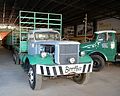 Kurt Johannsen's "Bertha" Diamond T 980
 Sherwin-Williams Paints truck on US 95 Nevada
 Tipper A-double in USA
 53 foot container turnpike double in Canada
 Triple trailer three 28.5-foot pups
 B-double with containers in the Netherlands
 B-double in Denmark
 A-double in South Africa
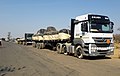 B-doubles in Zimbabwe
 A-double in Brazil
 Tri-axle prime mover with quad-axle trailers and tri-axle dolly in Australia
 Two steer axled prime mover
 A B-double on Newell Highway
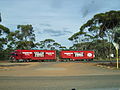 A-double
 A-triple
 B-triple
 AB-triple
 AAB quad
 BAB quad
.JPG&mode=clean)
.jpg&mode=clean)

.jpg&mode=clean)
.jpg&mode=clean)
.jpg&mode=clean)
DSC_2913_Balancer_(46436997621).jpg&mode=clean)
.jpg&mode=clean)


.jpg&mode=clean)

.jpg&mode=clean)

.jpg&mode=clean)

See also
[edit]
- Air brake (road vehicle)
- Articulated bus
- Brake
- Containerization
- Container on barge
- Container ship
- Dolly (trailer)
- Federal Bridge Weight Formula
- Fifth wheel coupling
- Gladhand connector
- Intermodal freight transport
- Jackknifing
- Longer Heavier Vehicle
- National Network – highway and interstate system
- Overland train
- Ringfeder coupling devices
- Road transport in Australia
- Rolling highway – freight trucks by rail
- Semi-trailer truck – large trucks such as road trains and articulated lorries
- Shipping container
- Top intermodal container companies list
- Trackless train
- Transport
References
[edit]- 1 2 "What is a Road Train?". X. Vintage Road Haulage, Perth, Western Australia. 2018. Retrieved 4 December 2018.
- ↑ Fuller, Basil (1975). The Ghan: The Story of the Alice Springs Railway. Rigby. ISBN 978-0727000163.
- 1 2 Beavan, Arthur H. (1903). Tube, Train, Tram, and Car or Up-to-date Locomotion. London: Routledge. p. 217.
- ↑ Layriz, Otfrie; Marston, Robert Bright (1900). Mechanical traction in war for road transport, with notes on automobiles generally. London: S. Low, Marston and Company. p. 20.
- ↑ The Illustrated war news. 29 November 1916.
- ↑ Wyatt, Horace Matthew (1914). Motor transports in war. Hodder and Stoughton. pp. 43–44.
- ↑ Burgess-Wise, David (17 August 2001). "A good idea at the time: Renard Road Train". The Daily Telegraph. ISSN 0307-1235. Retrieved 5 August 2018.
- ↑ Spooner, Stanley (1907). The Auto: The Motorist's Pictorial. Pictorial Press.
- ↑ "Farina 2016 works".
- ↑ View From The North – Episode Four: Roads North
- ↑ BBC Worldwide, Jeremy Clarkson's Motorworld, Australian episode
- ↑ 1934 AEC Road Train - Australia's First Road Train Vintage Road Haulage
- ↑ Graham, James (19 April 2023). "World-first electric triple road train launches in SA". Big Rigs. Retrieved 24 April 2024.
- ↑ "Do your staff know an A from B?". National Transport Insurance. 9 August 2021. Retrieved 30 September 2024.
- 1 2 RAVnet (Map). Government of South Australia. Retrieved 21 October 2016.
- ↑ "Heavy Vehicles". Main Roads Western Australia. Archived from the original on 12 March 2018. Retrieved 21 October 2016.
- 1 2 Hema Maps (Firm) & Martin, Ray. & Martin, Will. (2007), Australia truckies atlas [cartographic material] : the complete atlas for the professional driver / Hema Maps; [cartography, Ray Martin and Will Martin] – ISBN 978-1-86500-426-6 ISBN 1-865004-26-X – has state by state routes and route restrictions I
- ↑ "IMPROVING ROAD TRANSPORT FOR PRIMARY PRODUCTION PROJECT Status update" (PDF). Primary Industries and Regions SA. February 2018. Retrieved 24 August 2019.
- ↑ "Common Heavy Freight Vehicle Configurations – NHVR" (PDF). National Heavy Vehicle Regulator. Retrieved 24 August 2018.
- ↑ Carter, Russell A. (June 2012). "Taking the Train | E & MJ". www.e-mj.com.
heavy-duty, high-capacity haulage trailer equipped with a diesel engine, cooling system, transmission and drive axle system, all controlled from the Powertrans prime mover
- ↑ Shanks, Howard (14 September 2017). "1000 HP Kenworth C510 – Powertrailer combination Review". Australian Roadtrains.
body on the power-trans chassis .. engines rated at 450 and 500 horsepower. They are coupled to an Allison automatic transmission and tri-drive SISU hub reduction axles.
- ↑ "Australian Petroleum Statistics 2023". Department of Climate Change, Energy, the Environment and Water. December 2023.
slide page 7
- ↑ Graham, James (19 April 2023). "World-first electric triple road train launches in SA". Big Rigs.
- ↑ "Brisbane Truck Show uncovers huge clean transport shift, from utes to road trains – VASA". 24 July 2023.
around 25 per cent of the 40MWh consumed so far by a Janus-converted forestry truck – while covering 18,500km with loads of up to 68.5 tonnes of timber on a 24-hour duty cycle – had been harvested from regenerative braking
- ↑ "Truck Driver's Guide Book"
- ↑ "Fact #411 States that Allow Longer Combination Vehicles". U.S. Department of Energy – Energy Efficiency and Renewable Energy Vehicle Technologies Office. 13 February 2006.
- ↑ "Gangway! Here comes a turnpike train!", The Times-News (Hendersonville, N.C.), 30 November 1960, p. 7.
- ↑ "Chapter 3: Scenario Descriptions". Comprehensive Truck Size and Weight (CTS&W) Study (PDF). Vol. 3. US: Department of Transportation – Federal Highway Administration. Retrieved 28 September 2018.
- ↑ Timm, Chuck (2019). Encyclopedia of Made it Myself Ideas. Vol. 4. Lakeville, Minnesota: Farm Show. p. 51.
- ↑ "Effektive og miljørigtige lastbiler på de danske veje" (Press release) (in Danish). Transport og Energiministeriet. 24 November 2008. Archived from the original on 14 December 2008.
- ↑ Longer trucks next year
- ↑ The next environmental improvement – Long truck rigs Archived 14 September 2010 at the Wayback Machine Volvo Trucks Magazine 3 October 2008
- ↑ "Miljövänlig jättebil med timmer". Västerbottens-Kuriren (in Swedish). TT. 8 October 2010. Archived from the original on 24 July 2011.
- ↑ Largest lorry in western Europe to start operating in Finnish Lapland
- ↑ 104 ton experiment in northern Finland
- ↑ "Orden PRE/2788/2015, de 18 de diciembre, por la que se modifica el anexo IX del Reglamento General de Vehículos, aprobado por Real Decreto 2822/1998, de 23 de diciembre" [Order PRE/2788/2015, of 18 December, amending Annex IX of the General Vehicle Regulations, approved by Royal Decree 2822/1998, of 23 December] (PDF) (in Spanish). Archived from the original (PDF) on 15 February 2019.
- ↑ DGT; Ministerio interior. "Dúo-Tráiler grande entre los grandes". www.dgt.es (in Spanish). Retrieved 6 November 2024.
- ↑ "Sustainable Transport". eoingavintransport.com. 8 April 2021. Retrieved 6 August 2024.
- ↑ "TPN Ireland launches new 19.5m trailer". tpn.ie. 24 February 2024. Retrieved 6 August 2024.
- 1 2 "NORMA Oficial Mexicana NOM-012-SCT-2-2014, Sobre el peso y dimensiones máximas con los que pueden circular los vehículos de autotransporte que transitan en las vías generales de comunicación de jurisdicción federal". Official Journal of the Federation (Mexico) (in Spanish). 11 November 2014. Retrieved 16 May 2023.
{{cite web}}: CS1 maint: deprecated archival service (link) - ↑ Notice of regulation https://www.elmananerodiario.com/los-doble-remolque-no-se-prohiben-tendran-regulacion-mas-estricta/
- ↑ "Next Stop: Transform the Future – Motorindia". Retrieved 22 August 2025.
- ↑ Code of Practice for Type Approval of Trailers / Semi-Trailers of categories T2, T3 and T4 being towed by Motor Vehicles of categories N2 and N3. Automotive Research Association of India (ARAI). 14 December 2023.
- ↑ "Volvo truck pioneers high efficiency logisitics". Manufacturing Today India. 15 February 2025. Retrieved 11 March 2025.
- ↑ Muscat Trailer website
- ↑ "Code of Practice for B-Doubles" (PDF). Government of South Australia, Department for Transport, Energy and Infrastructure. June 2011. p. 3. MR 414 06/11. Archived from the original (PDF) on 21 October 2016. Retrieved 8 February 2016.
- ↑ "Into the Details: All About Road Trains". Equipment Hunt Group Pty Ltd. April 2019. Retrieved 9 April 2019.
- ↑ Sweatman, P.; Tso, Y. (29 July 1988). "Dynamic stability of B-doubles". Transportation Planning and Technology. 14 (2): 159–169. doi:10.1080/03081068908717423.
- 1 2 3 RAVnet (Map). Government of South Australia. Retrieved 26 July 2020.
- ↑ "A history of Australias trailer boom". fullyloaded.com.au. 18 June 2018.
- ↑ COAG backs B-triple network Archived 29 July 2008 at the Wayback Machine, ntc.gov.au
- ↑ Bereni, Matthieu; Rob Di Cristoforo (2012). "Connecting Australia with Modular B-Triples". Transportation Research Record. 2288 (2288). Washington, D.C.: 57–65. doi:10.3141/2288-07. S2CID 110027645.
- ↑ Transport for NSW (August 2022). "Modular B-triple access in NSW" (PDF).
- ↑ VIC transport operation reports breakthrough efficiencies with PBS B-quad combination primemovermag.com.au, 15 March 2019
- ↑ "The New Breed – First Super Quad hits the road in Western Australia Pilbara". Roadtrains Australia. 20 November 2015. Retrieved 30 September 2024.
- ↑ Kate (12 October 2015). "Bruce Rock Engineering introduces industry-first super-quad road train trial". Bruce Rock Engineering. Retrieved 30 September 2024.
- ↑ Transport for NSW (August 2022). "Rigid Truck and Two Dog Trailer Combination (Rigid Combination)" (PDF).
- ↑ Interstate Road Transport Charge Amendment Bill 1998 (Bills Digest 192 1997–98)
- ↑ NHVR (21 August 2025). "Vehicle Standards Guide 19 (VSG-19) Vehicle warning signs (LONG VEHICLE and ROAD TRAIN)" (PDF).
- ↑ "Concessional Mass Limits". National Heavy Vehicle Regulator (nhvr.gov.au). Retrieved 1 December 2019.
- ↑ "Road train speed limits | NHVR". www.nhvr.gov.au. Retrieved 10 May 2024.
- ↑ "B-triple road train rule changes for Queensland". Big Rigs. 12 September 2022. Retrieved 10 May 2024.
- ↑ Pearson, John R. (1989). "Medium combination vehicle use in Canada". Transportation Planning and Technology. 14 (2): 126. doi:10.1080/03081068908717420.
- ↑ "Vehicle Road Speed Limiters (RSL)". Transport's Friend. Retrieved 1 August 2024.
- 1 2 3 4 5 Doug's Tug Archived 30 September 2009 at the Wayback Machine, the pick & shovel (13), December 2000.
- ↑ The world's longest roadtrain Truck & Bus Transportation June 1994 page 6
- ↑ The Truck Pull : The World's Longest Road Train, marleystransport.com
- ↑ World records : Preparations for the Big Attempt Archived 12 April 2009 at the Wayback Machine, gouldtransport.com.au, quoted from Kalgoorlie Miner, Friday 10 November 2000.
- ↑ TALKIN' TITAN TOUGH Archived 20 August 2011 at the Wayback Machine, 21 November 2005, macktrucks.com.au
- ↑ Monster Update : ROAD TRAIN RECORD Archived 26 August 2009 at the Wayback Machine Fleet Watch,
- ↑ Former road train record holder may take on new challenge, 22 February 2006, ABC News online,
- ↑ "Longest road train". Guinness World Records. 18 February 2006. Retrieved 5 December 2019.
- ↑ Australia's New World Record Road Train Pull, thedieselgypsy.com
- ↑ Qld truck driver sets world's longest road train record, 19 February 2006, ABC News.
- ↑ Bulldog Reclaims Record Down Under, macktrucks.com
- ↑ "Volvo FH16 and I-Shift with crawler gears pulls 750 tonnes from standstill". 12 April 2016.
External links
[edit]
- Australian Road Train Association
- Australian National Heavy Vehicles Accreditation Scheme.
- Northern Territory Road Train road safety TV commercials. Archived 19 March 2007 at the Wayback Machine
- South Australian Roads road train gazette
- NSW Roads and Traffic Authority road train operators gazette
- NSW Roads and Traffic Authority Restricted Access Vehicles route map index
- NSW Roads and Traffic Authority Reflective sign standards
- U.S. department of Transportation, Federal Highway Administration, Chapter VII, Safety.
- The U.S. Department of Transportation's Western Uniformity Scenario Analysis.
- British Columbia Government Licensing Bulletin 6
- British Columbia Government Licensing Bulletin 41
- Roadmap of technologies able to halve energy use per passenger mile includes the dynamically coupled, heterogeneous type of roadtrain
- Road trains and electrification of transport
- Combination Vehicles for Commercial Drivers License