


| Part of a series on |
| Japanese mythology and folklore |
|---|
 |
| Mythic texts |
| Divinities |
| Legendary creatures and urban legends |
| Mythical and sacred locations |
| Sacred objects |
| Shintō and Buddhism |
Yōkai (妖怪; Japanese pronunciation: [joː.kai][1]) are a class of supernatural entities and spirits in Japanese folklore. Yōkai are a vast range of beings, including shapeshifters, ghosts, demons, and tricksters. They can be mischievous, helpful, or malevolent, often appearing as animal-like figures, possessed objects, or humanoids. They embody the mysterious and uncanny aspects of nature and human emotions.[2]
Yōkai are also referred to as ayakashi (あやかし), mononoke (物の怪) or mamono (魔物). Some academics and Shinto practitioners acknowledge similarities within the seeming dichotomy between the natures of yōkai and most kami, which are generally regarded as relatively beneficent in comparison, and class the two as ultimately the same type of spirits of nature or of a mythological realm.[3] Their behavior can range from malevolent or mischievous to benevolent towards humans.
Yōkai often have animal-like features (such as the kappa, depicted as appearing similar to a turtle, and the tengu, commonly depicted with wings), but may also appear humanoid in appearance, such as the kuchisake-onna (口裂け女). Some yōkai resemble inanimate objects (such as the tsukumogami), while others have no discernible shape. Yōkai are typically described as having spiritual or supernatural abilities, with shapeshifting being the most common trait associated with them. Yōkai that shapeshift are known as bakemono (化け物) or obake (お化け).
Japanese folklorists and historians, such as Michael Foster, describe yōkai as part of how humans "fashion from a perilous landscape something concrete [...] the naming of yōkai identifies the threat, specifying the nature of the danger..."[4] In the Edo period (1603 to 1868), many artists, such as Toriyama Sekien (1712-1788), invented new yōkai by taking inspiration from folktales or purely from their imagination. Today, several such yōkai (such as the amikiri) are mistakenly thought to originate in more traditional folklore.[5]
The kanji representation of the word yōkai comprises two characters that both mean "suspicious, doubtful",[6] and while the Japanese name is simply the Japanese transliteration or pronunciation of the Chinese term yāoguài (which designates similarly strange creatures), some Japanese commentators argue that the word yōkai has taken on many different meanings in Japanese culture,[7] including referring to a large number of uniquely Japanese creatures.
Concept
[edit]The concept of yōkai varies greatly throughout Japanese culture and historical periods; typically, the older the time period, the higher the number of phenomena deemed to be supernatural and the result of yōkai.[8] According to Japanese ideas of animism, spirit-like entities were believed to reside in all things, including natural phenomena and objects.[9] Such spirits possessed emotions and personalities: peaceful spirits were known as nigi-mitama, who brought good fortune; violent spirits, known as ara-mitama, brought ill fortune, such as illness and natural disasters. Neither type of spirit was considered to be yōkai.
One's ancestors and particularly respected departed elders could also be deemed to be nigi-mitama, accruing status as protective spirits who brought fortune to those who worshiped them. Animals, objects and natural features or phenomena were also venerated as nigi-mitama or propitiated as ara-mitama depending on the area.
Rituals for converting ara-mitama into nigi-mitama were performed, aiming to quell malevolent spirits, prevent misfortune and alleviate the fear arising from phenomena and events that otherwise had no explanation.[10][11] The ritual for converting ara-mitama into nigi-mitama was known as the chinkon (鎮魂, lit. 'the calming of the spirits' or 'requiem').[12] Chinkon rituals for ara-mitama that failed to achieve deification as benevolent spirits, whether through a lack of sufficient veneration or through losing worshippers and thus their divinity, became yōkai.[13][14]
Over time, phenomena and events thought to be supernatural became fewer and fewer, with the depictions of yōkai in picture scrolls and paintings beginning to standardize, evolving more into caricatures than fearsome spiritual entities. Elements of the tales and legends surrounding yōkai began to be depicted in public entertainment, beginning as early as the Middle Ages in Japan.[15] During and following the Edo period, the mythology and lore of yōkai became more defined and formalized.[16]
In Japan before the Meiji period, supernatural beings were rarely referred to as yōkai. Most of the supernatural entities known as yōkai today were instead called by other names, such as oni or bakemono, during the pre-Meiji era. The reason the word yōkai has become the standard term for supernatural beings in modern Japan used both academically and in everyday language is due to a Meiji-era scholar named Inoue Enryō (Japanese: 井上 円了). He established an academic discipline called yōkaigaku (yōkaiology) in an effort to eradicate superstitions surrounding them.[17]


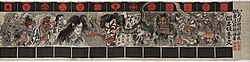 Theatre Curtain with Yokai by Kawanabe Kyōsai (1880)


Types
[edit]The folklorist Tsutomu Ema studied the literature and paintings depicting yōkai and henge (変化, lit. 'changed things/mutants'), dividing them into categories as presented in the Nihon Yōkai Henge Shi and the Obake no Rekishi:
- Categories based on a yōkai's "true form":
- Human
- Animal
- Plant
- Object
- Natural phenomenon
- Categories depending on the source of mutation:
- Mutation related to this world
- Spiritual or mentally related mutation
- Reincarnation or afterworld related mutation
- Material related mutation
- Categories based on external appearance:
- Human
- Animal
- Plant
- Artifact
- Structure or building
- Natural object or phenomenon
- Miscellaneous or appearance compounding more than one category
In other folklorist categorizations, yōkai are classified, similarly to the nymphs of Greek mythology, by their location or the phenomena associated with their manifestation. Yōkai are indexed in the book Sogo Nihon Minzoku Goi (綜合日本民俗語彙, A Complete Dictionary of Japanese Folklore)[19][a] as follows:
- dōbutsu no ke (動物の怪; animals, either real or imaginary)
- ki no ke (木の怪; trees)
- michi no ke (道の怪; paths)
- mizu no ke (水の怪; water)
- oto no ke (音の怪; sound)
- umi no ke (海の怪; the sea)
- yama no ke (山の怪; mountains)
- yuki no ke (雪の怪; snow)
History
[edit]Ancient history
[edit]- 772 CE: In the Shoku Nihongi, there is the statement "Shinto purification is performed because yōkai appear very often in the imperial court," using the word yōkai to not refer to any one phenomenon in particular, but to strange phenomena in general.
- Middle of the Heian period (794–1185/1192): In The Pillow Book by Sei Shōnagon, there is the statement "there are tenacious mononoke," as well as a statement by Murasaki Shikibu that "the mononoke have become quite dreadful," which are the first appearances of the word mononoke.
- 1370: In the Taiheiki, in the fifth volume, there is the statement, "Sagami no Nyudo was not at all frightened by yōkai."

The ancient times were a period abundant in literature and folktales mentioning and explaining yōkai. Literature such as the Kojiki, the Nihon Shoki, and various Fudoki expositioned on legends from the ancient past, and mentions of oni, orochi, among other kinds of mysterious phenomena can already be seen in them.[20] In the Heian period, collections of stories about yōkai and other supernatural phenomena were published in multiple volumes, starting with publications such as the Nihon Ryōiki and the Konjaku Monogatarishū, and in these publications, mentions of phenomena such as Hyakki Yagyō can be seen.[21]
The yōkai that appear in this literature were passed on to later generations.[22] Despite the literature mentioning and explaining these yōkai, they were never given any visual depictions. In Buddhist paintings such as the Hell Scroll (Nara National Museum), which came from the later Heian period, there are visual expressions of the idea of oni, but actual visual depictions would only come later in the Middle Ages, from the Kamakura period and beyond.[23]
Yamata no Orochi was originally a local god but turned into a yōkai who was slain by Susanoo.[24] Yasaburo was originally a bandit whose vengeful spirit (onryō) turned into a poisonous snake upon death and plagued the water in a paddy, but eventually became deified as the "wisdom god of the well."[25] Kappa and inugami are sometimes treated as gods in one area and yōkai in other areas. From these examples, it can be seen that among Japanese gods, there are some beings that can go from god to yōkai and vice versa.[26][27]
Post-classical history
[edit]
Medieval Japan was a time period where publications such as emakimono, Otogi-zōshi, and other visual depictions of yōkai started to appear. While there were religious publications such as the Jisha Engi (寺社縁起), others, such as the Otogizōshi, were intended more for entertainment, starting the trend where yōkai became more and more seen as subjects of entertainment. For examples, tales of yōkai extermination could be said to be a result of emphasizing the superior status of human society over yōkai.[15] Publications included:
- The Ooe-yama Shuten-doji Emaki (about an oni), the Zegaibou Emaki (about a tengu), the Tawara no Tōda emaki (俵藤太絵巻) (concerning serpent/dragon-folk oppressed by a giant centipede yōkai), the Tsuchigumo Zoshi (土蜘蛛草紙) (about tsuchigumo), and the Dojo-ji Engi Emaki (about a giant snake). These emaki were about yōkai that come from even older times.
- The Kitano Tenjin Engi Emaki, in which Sugawara no Michizane was a lightning god who took on the form of an oni, and despite attacking people after doing this, he was still deified as a god in the end.[15]
- The Junirui Emaki, the Tamamono Soshi, (both about Tamamo-no-Mae), and the Fujibukuro Soushi Emaki (about a monkey). These emaki told of yōkai mutations of animals.
- The Tsukumogami Emaki, which told tales of thrown away, not-too-precious objects that come to have a spirit residing in them planning evil deeds against humans, and ultimately get exorcised and sent to peace.
Comparison with yaoguai
[edit]Both the Chinese yaoguai (Chinese: 妖怪; pinyin: yāoguài) and Japanese yōkai include strange, supernatural beings with shapeshifting tendencies. In the Chinese version, the emphasis is often on the first character, 妖 (yāo, yō), which connotes bewilderment, enchantment, or supernatural affliction — for example, their ability to take on human form in order to seduce and to enthrall human beings. In Japanese yōkai, the emphasis appears to be on the 怪 (guài, kai), referring to their monstrous and aberrant nature and anatomy. Depictions of Japanese yōkai in popular culture often include elements of the cute, the comical, the goofy, and the bizarre.
Some creatures appear as both Chinese yaoguai and Japanese yōkai, such as the scaly "water tiger" 水虎 (shuǐhǔ, suiko), the wilderness demons 魑魅魍魎 (chīmèi wǎngliǎng, chimimōryō), and the nine-tailed foxes 九尾狐 (jiǔwěihú, kyūbiko; also called 九尾の狐 (kyūbi no kitsune) in Japanese).
Some yōkai, such as the nekomata (cat yōkai) and tanuki (raccoon yōkai), resemble Chinese yaoguai, which encompass any number of shapeshifting animals and plants that have learnt to cultivate human form and other supernatural arts. For example, the nekomata resembles the Chinese xiānlí (仙狸, 'leopard cat immortal'; Japanese: senri).
Yet others are uniquely Japanese, such as the kappa, ambivalent and occasionally cute,[38] the haradashi, with its belly on its face,[39] and the mumashika, a comical-looking yokai with a horse head and a deer body.[40]
In popular culture
[edit]Yōkai are often referred to as Japanese spirits or East Asian ghosts, like the Hanako-san legend or the story of the "Slit-mouthed girl," both of which hail from Japanese legend. The term yōkai can also be interpreted as something strange or unusual.
Lafcadio Hearn's collection of Japanese ghost stories entitled Kwaidan: Stories and Studies of Strange Things includes stories of yūrei and yōkai such as Yuki-onna, and is one of the first Western publications of its kind.
Yōkai remain prevalent in modern works of fiction. Shigeru Mizuki, the manga creator of such series as GeGeGe no Kitaro and Kappa no Sanpei, keeps yōkai in the popular imagination. Other popular works focusing on yōkai include the Nurarihyon no Mago series, Yu Yu Hakusho, Inuyasha: A Feudal Fairy Tale, Yo-kai Watch and the 1960s Yokai Monsters film series, which was loosely remade in 2005 as Takashi Miike's The Great Yokai War and more recently Yukinobu Tatsu's Dandadan and the video games Genshin Impact, Phasmophobia and Nioh series.
See also
[edit]
Japanese supernatural beings
- Kappa – a type of yōkai
- Oni – a type of yōkai
- Tengu – a type of yōkai
- Yōsei – Spiritlike creature from Japanese folklore, distinct from the yōkai
- Yūrei – Figures in Japanese folklore similar to ghosts, distinct from the yōkai
Japanese museums on the supernatural
Other supernatural beings from East Asian folklore
- Dokkaebi – Creatures from Korean folklore
- Ghosts in Chinese culture – Some Chinese ghosts are identical to the Japanese yūrei in character or nature
- Kijimunaa – Indigenous Ryukyuan belief system (legendary beings from the Ryukyu Islands)
- Mogui – A class of Chinese demons from Buddhism
- Yaoguai – A class of Chinese supernatural beings with shapeshifting abilities and other supernatural powers.
Lists of supernatural creatures from East Asian folklore
- List of legendary creatures from Japan – Legendary creatures and entities in traditional Japanese mythology
- List of supernatural beings in Chinese folklore – Legendary creatures and entities in Chinese folklore, many of which also recur in Japanese lore
References
[edit]Notes
[edit]- ↑ The index has the heading reikai (霊怪; "spirits and monsters"), under which reikai (霊怪), yōkai (妖怪), tsukimono (憑物; "possession by spirits").
- ↑ Picture books classed as a kusazōshi included further subcategories named after the colors of their jackets. A kibyōshi (yellow) referred to those catering to adult audiences; there were also akabyōshi (red) and aobyōshi (blue).
Citations
[edit]- ↑
- ↑ Tsujiguchi, Lucia (21 January 2025). "Yokai: Discover the History of Japan's Legendary Monsters". VOYAPON. Retrieved 13 December 2025.
- ↑
Foster, Michael Dylan (14 January 2015). "Introducing Yōkai". The Book of Yōkai: Mysterious Creatures of Japanese Folklore. Oakland, California: University of California Press. pp. 20–21. ISBN 978-0-520-27102-9. Retrieved 14 September 2024.
[...] although it is tempting to think in terms of a simple opposition - kami good and yōkai bad - the line between the two is blurry. Yanagita Kunio, the father of folkloristics in Japan, suggested that yōkai are kami that have 'degraded' over time, an idea that suggests an intimate relationship between the two. [...] Folklorist-anthropologist Komatsu Kazuhiko has suggested that yōkai are 'unworshipped' kami and kami are 'worshipped' yokai. [...] Both kami and yōkai reflect a way of thinking often called animistic, meaning that the things in the world around us - rocks, rivers, even musical instruments - can possess animating forces or spirits. Within such an animistic world, we can imagine a continuum. On one end, where yōkai cluster, we have everything that seems troublesome, undesirable, unworshipped. The other end contains helpful, desirable, and worshipped things - generally called kami. But these are extremes, and any individual entity can move along this continuum. If a 'bad' yōkai does something 'good,' we might consider it a kami, and vice versa.
- ↑ Foster (2009), pp. 10–11.
- ↑ "Toriyama Sekien". Obakemono. The Obakemono Project. Archived from the original on 26 July 2013. Retrieved 2 April 2021.
- ↑ Foster (2009), p. 13 "[...] both of the graphs that signify yōkai, 妖, and 怪, carry the meaning of 'suspicious' or 'doubtful.'"
- ↑ Hirota (2021), p. 332.
- ↑ Komatsu (2015), p. 24.
- ↑ Komatsu (2011), p. 16.
- ↑ Miyata (2002), p. 14.
- ↑ Komatsu (2015), pp. 201–204.
- ↑ Komatsu (2011), pp. 16–18.
- ↑ Miyata (2002), pp. 12–14.
- ↑ Komatsu (2015), pp. 205–207.
- 1 2 3 Komatsu (2011), pp. 21–22.
- ↑ Komatsu (2011), pp. 188–189.
- ↑ "[考える広場] 妖怪と日本人 水木しげる生誕100年". Tokyo Shimbun (in Japanese). Retrieved 20 July 2022.
- ↑ Kondō, Mizuki; Saeki, Takahiro (2007), Saikaku to Ukiyoe zōshi kenkyū: dai-2-gō furoku. Kaiibutsu sashie taizen 西鶴と浮世草子研究 第二号付録 怪異物挿絵大全, Kasama shoin, ISBN 978-4-305-60202-2
- ↑ Minzokugaku kenkyujo (1956). Sōgō nihon minzoku goi 綜合日本民俗語彙. Vol. 5. Heibonsha. pp. 403–407.
- ↑ Komatsu (2011), p. 20.
- ↑ "Sonshō darani no genriki ni yorite oni no nan wo nogaruru koto" 尊勝陀羅尼の験力によりて鬼の難を遁るる事 [Escaping the oni by the spiritual power of the Vijaya Dharani], Konjaku monogatarishū 今昔物語集 (in Japanese), Book 14, No. 42
- ↑ Komatsu (2011), p. 78.
- ↑ Komatsu2011, p. 21.
- ↑ Komatsu (2015), p. 46.
- ↑ Komatsu (2015), p. 213.
- ↑ Miyata (2002), p. 12.
- ↑ Komatsu (2015), p. 200.
- ↑ Tachikawa, Kiyoshi (1987). Hyakumonogatari kaidanshū 百物語怪談集成. Kokusho Kankokai. pp. 365–367.
- ↑ "Sesetsu kojien 3" 世説故事苑 3巻. 1716. Retrieved 16 December 2015.
- ↑ Kabat, Adam ed., tr. [in Japanese] (February 1999). Edo bakemono zōshi 江戸化物草紙. Shogakukan. p. 29. ISBN 4-09-362111-X.
- ↑ Yumoto, Kōichi [in Japanese] (2008). "Asobi no naka no yōkai" 遊びのなかの妖怪. In Kōdansha Comic Create (ed.). DISCOVER yōkai: nihon yōkai daihyakka DISCOVER妖怪 日本妖怪大百科. KODANSHA Official File Magazine. Vol. 10. Kodansha. pp. 30–31. ISBN 978-4-06-370040-4.
- 1 2 Yamaguchi, Bintarō [in Japanese] (2007). Hontō ni iru nihon no 'gendai yōkai' zukan 本当にいる日本の「現代妖怪」図鑑. Kasakura. p. 9. ISBN 978-4-7730-0365-9.
- ↑ "Toshi densetsu to yōkai" 都市伝説と妖怪. DISCOVER妖怪 日本妖怪大百科. Vol. 10. p. 2.
- 1 2 3
- 1 2 3 Yōkaiō (Yamaguchi Bintarō) Group [in Japanese] (2003). Shōwa no kodomo: Natsukashi no yōkai zukan 昭和の子供 懐しの妖怪図鑑. Art Book hon no mori. pp. 16–19. ISBN 4-7747-0635-3.
- ↑ Mizuki, Shigeru (1974). Yōkai nandemo nyūmon 妖怪なんでも入門. Shogakukan. p. 17. ISBN 4-09-220032-3.
- ↑ "Japanese Yokai Meaning & List with Pictures of these Demons". Japan Avenue. Retrieved 19 July 2024.
- ↑ "Haradashi – Yokai.com". yokai.com. Retrieved 19 July 2024.
- ↑ "Mumashika – Yokai.com". yokai.com. Retrieved 19 July 2024.
Works cited
[edit]- Foster, Michael Dylan (2009). Pandemonium and Parade: Japanese Monsters and the Culture of Yōkai. University of California Press. ISBN 978-0-520-25361-2.
- Hirota, Ryūhei (2021). "Traversing the Natural, Supernatural, and Paranormal: Yōkai in Postwar Japan". Japanese Journal of Religious Studies. 48 (2, Religion and Identity in Japan since 1940): 321–340. doi:10.18874/jjrs.48.2.2021.321-339. JSTOR 27039930. S2CID 237709697.
- Komatsu, Kazuhiko [in Japanese] (2011). Yōkaigaku no kiso chishiki 妖怪学の基礎知識 (in Japanese). Kadokawa gakugei shuppan. ISBN 978-4-04-703487-7.
- Komatsu, Kazuhiko [in Japanese] (2015). Yōkaigaku shinkō: Yōkai kara miru nihonjin no kokoro 妖怪学新考 妖怪からみる日本人の心 (in Japanese). Kodansha. ISBN 978-4-06-292307-1.
- Miyata, Noboru [in Japanese] (2002). 妖怪の民俗学 (in Japanese). Chikuma shobo. ISBN 4-480-08699-4.
- Ballaster, Ros (2005). Fables of the East. Oxford University Press. ISBN 0-19-926735-9.
- Fujimoto, N. (2008). "Yôkai und das Spiel mit Fiktion in der edozeitlichen Bildheftliteratur" (PDF). Nachrichten der Gesellschaft für Natur- und Völkerkunde Ostasiens (in German). 78 (183–184). University of Hamburg: 93–104. Archived from the original (PDF) on 19 February 2022.
- Hearn, L. (2005). Kwaidan: Stories and Studies of Strange Things. Tuttle Publishing.
- Komatsu, K. [in Japanese] (2017). An Introduction to Yōkai Culture: Monsters, Ghosts, and Outsiders in Japanese History. Japan Publishing Industry Foundation for Culture. ISBN 978-4-86658-049-4.
- Meyer, Matthew (2012). The Night Parade of One Hundred Demons. Matthew Meyer. ISBN 978-0-9852-1840-9.
- Phillip, Neil (2000). Annotated Myths & Legends. Covent Garden Books. ISBN 0-7513-3097-3.
- Tyler, Royall (1987). Japanese Tales. Pantheon Fairy Tale & Folklore Library. Random House. ISBN 0-394-52190-0.
- Williams, S. (2018). 妖怪の民俗学 [Silver Crossed Skies] (in Japanese). Frosty Snow Monk Publishing. ISBN 978-4-480-08699-0.
- Yoda, Hiroko; Alt, Matt (2012). Yokai Attack! The Japanese Monster Survival Guide. Tuttle Publishing. ISBN 978-4-8053-1219-3.
- Yoda, H.; Alt, M. (2016). Japandemonium Illustrated: The Yokai Encyclopedias of Toriyama Sekien. Dover Publishing. ISBN 978-0-4868-0035-6.
External links
[edit]
- Yōkai and Kaidan (PDF; 1.1 MB)
- The Ōishi Hyōroku Monogatari Picture Scroll
- Database of images of Strange Phenomena and Yōkai (Monstrous Beings) Archived 1 March 2022 at the Wayback Machine
- "Special Section on Japanese Monsters and Yokai," Education About Asia (spring 2026), Association of Asian Studies (USA)
- Collection: Supernatural in Japanese Art Archived 24 February 2021 at the Wayback Machine, from University of Michigan Museum of Art


| International | |
|---|---|
| National | |
| Other | |
