While dementia affects 6-10% of persons 65 years or older, industrialized countries have witnessed an alarming rise in obesity. However, obesity's influence on dementia remains poorly understood. We conducted a systematic review and meta-analysis. PUBMED search (1995-2007) resulted in 10 relevant prospective cohort studies of older adults (40-80 years at baseline) with end points being dementia and predictors including adiposity measures, such as body mass index (BMI) and waist circumference (WC). There was a significant U-shaped association between BMI and dementia (P = 0.034), with dementia risk increased for obesity and underweight. Pooled odds ratios (OR) and 95% confidence intervals (CI) for underweight, overweight and obesity compared with normal weight in relation to incident dementia were: 1.36 (1.07, 1.73), 0.88 (0.60, 1.27) and 1.42 (0.93, 2.18) respectively. Pooled ORs and 95% CI for obesity and incident Alzheimer's disease (AD) and vascular dementia were 1.80 (1.00, 3.29) vs. 1.73 (0.47, 6.31) and were stronger in studies with long follow-up (>10 years) and young baseline age (<60 years). Weight gain and high WC or skin-fold thickness increased risks of dementia in all included studies. The meta-analysis shows a moderate association between obesity and the risks for dementia and AD. Future studies are needed to understand optimal weight and biological mechanisms.
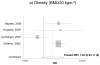
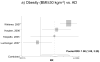
The association between BMI categories and incident dementia* * Based on fully adjusted…
Figure 1
The association between BMI categories and incident dementia* * Based on fully adjusted models (sociodemographic+lifestyle
and/or co-morbid conditions and/or genetic factors), for both genders together,
and normal BMI range being the reference category.
Figure 1
The association between BMI categories…
Figure 1
The association between BMI categories and incident dementia* * Based on fully adjusted…
Figure 1
The association between BMI categories and incident dementia* * Based on fully adjusted models (sociodemographic+lifestyle
and/or co-morbid conditions and/or genetic factors), for both genders together,
and normal BMI range being the reference category.
Figure 1
The association between BMI categories…
Figure 1
The association between BMI categories and incident dementia* * Based on fully adjusted…
Figure 1
The association between BMI categories and incident dementia* * Based on fully adjusted models (sociodemographic+lifestyle
and/or co-morbid conditions and/or genetic factors), for both genders together,
and normal BMI range being the reference category.
Figure 2
The association between obesity and…
Figure 2
The association between obesity and incident AD and VaD* * Based on fully…
Figure 2
The association between obesity and incident AD and VaD* * Based on fully adjusted models (sociodemographic+lifestyle
and/or co-morbid conditions and/or genetic factors), for both genders together,
and normal BMI range being the reference category. AD: Alzheimer’s Disease; VaD: Vascular Dementia.
Figure 2
The association between obesity and…
Figure 2
The association between obesity and incident AD and VaD* * Based on fully…
Figure 2
The association between obesity and incident AD and VaD* * Based on fully adjusted models (sociodemographic+lifestyle
and/or co-morbid conditions and/or genetic factors), for both genders together,
and normal BMI range being the reference category. AD: Alzheimer’s Disease; VaD: Vascular Dementia.
Figure 3
Population Attributable Risk with 95%…
Figure 3
Population Attributable Risk with 95% CI for obesity and dementia and its subtypes…
Figure 3
Population Attributable Risk with 95% CI for obesity and dementia and its
subtypes using current estimates of adult obesity prevalence (NHANES,
1999–2002)* Source: *Estimates of obesity prevalence were applied to the PAR formula as the
average for the age groups (40–59 and 60+), which was
33.35%.
Appendix A
Funnel plot for all RR,…
Appendix A
Funnel plot for all RR, HR and OR measures used for meta-analysis: assessment…
Appendix A
Funnel plot for all RR, HR and OR measures used for meta-analysis: assessment of
publication bias for fully adjusted models with BMI (categories) as main
exposure (n=52 datapoints)* * Egger’s regression asymmetry test: −0.14±0.54,
P=0.791; Begg-adjusted rank correlation test: z=0.62; P=0.533. † RR: Relative Risk; HR: Hazard Ratio; OR: Odds Ratio; s.e.: standard
error.
Hendrie HC. Epidemiology of dementia and Alzheimer’s disease. Am J Geriatr Psychiatry. 1998;6:S3–18.
-
PubMed
Centers of Disease Control and Prevention. Death: preliminary data 2003. Natl Vital Stat Rep. 2005:53.
-
PubMed
Dewey ME, Saz P. Dementia, cognitive impairment and mortality in persons aged 65 and over living in the community: a systematic review of the literature. Int J Geriatr Psychiatry. 2001;16:751–61.
-
PubMed
Abate C, Ferrari-Ramondo V, Di Iorio A. Risk factors for cognitive disorders in the elderly: A review. Archives of Gerontology and Geriatrics. 1998;(suppl 6):7–15.
Clarke R, Smith AD, Jobst KA, Refsum H, Sutton L, Ueland PM. Folate, vitamin B12, and serum total homocysteine levels in confirmed Alzheimer disease. Arch Neurol. 1998;55:1449–55.
-
PubMed