Purpose:
Concurrent chemoradiotherapy (CCRT) for squamous cell carcinoma of the head and neck (SCCHN) increases both local tumor control and toxicity. This study evaluates clinical factors that are associated with and might predict severe late toxicity after CCRT.
Methods:
Patients were analyzed from a subset of three previously reported Radiation Therapy Oncology Group (RTOG) trials of CCRT for locally advanced SCCHN (RTOG 91-11, 97-03, and 99-14). Severe late toxicity was defined in this secondary analysis as chronic grade 3 to 4 pharyngeal/laryngeal toxicity (RTOG/European Organisation for the Research and Treatment of Cancer late toxicity scoring system) and/or requirement for a feeding tube >or= 2 years after registration and/or potential treatment-related death (eg, pneumonia) within 3 years. Case-control analysis was performed, with a multivariable logistic regression model that included pretreatment and treatment potential factors.
Results:
A total of 230 patients were assessable for this analysis: 99 patients with severe late toxicities and 131 controls; thus, 43% of assessable patients had a severe late toxicity. On multivariable analysis, significant variables correlated with the development of severe late toxicity were older age (odds ratio 1.05 per year; P = .001); advanced T stage (odds ratio, 3.07; P = .0036); larynx/hypopharynx primary site (odds ratio, 4.17; P = .0041); and neck dissection after CRT (odds ratio, 2.39; P = .018).
Conclusion:
Severe late toxicity after CCRT is common. Older age, advanced T-stage, and larynx/hypopharynx primary site were strong independent risk factors. Neck dissection after CCRT was associated with an increased risk of these complications.
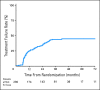
Time to severe late toxicity (shown in the graph as Treatment Failure Rates):…
Fig 1.
Time to severe late toxicity (shown in the graph as Treatment Failure Rates): all assessable patients.
Fig 2.
Time to severe late toxicity…
Fig 2.
Time to severe late toxicity (shown in the graphs as Treatment Failure Rate):…
Fig 2.
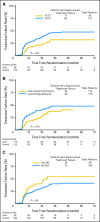
Time to severe late toxicity (shown in the graphs as Treatment Failure Rate): subgroup analyses based on patient/treatment characteristics. All graphs exclude two patients who had neck dissection after already experiencing a severe late toxicity. (A) Time to severe late toxicity by T stage. Advanced T stage is associated with a higher likelihood of severe late toxicity (P value from Gray's test = .031). (B) Time to severe late toxicity by primary tumor site. Larynx/hypopharynx cancer is associated with a statistically nonsignificant higher likelihood of severe late toxicity (P value from Gray's test = .076). (C) Time to severe late toxicity by neck dissection (ND). ND is associated with a statistically nonsignificant higher likelihood of severe late toxicity (P value from Gray's test = .09).
Bourhis J, LeMaitre A, Baujat B, et al: Individual patients' data meta-analyses in head and neck cancer. Curr Opin Oncol 19:188-194, 2007
-
PubMed
Pignon JP, Bourhis J, Domenge C, et al: Chemotherapy added to locoregional treatment for head and neck squamous cell carcinoma: Three meta-analyses of updated individual data. Lancet 355:949-955, 2000
-
PubMed
Brizel DM, Albers MA, Fisher SR, et al: Hyperfractionated irradiation with or without concurrent chemotherapy for locally advanced head and neck cancer. N Engl J Med 328:1798-1804, 1998
-
PubMed
Wendt TG, Grabenbauer CG, Rodel CM, et al: Simultaneous radiochemotherapy versus radiotherapy alone in advanced head and neck cancer: A randomized multicenter study. J Clin Oncol 16:1318-1324, 1998
-
PubMed
Calais G, Alfonsi M, Bardet E, et al: Randomized study comparing radiation alone RT versus concomitant chemotherapy and radiation therapy for advanced-stage oropharynx carcinoma. J Natl Cancer Inst 91:2081-2086, 1999
-
PubMed