Purpose:
To determine the prognostic importance of p16 and human papillomavirus (HPV) in patients with oropharyngeal cancer treated on a phase III concurrent chemoradiotherapy trial.
Patients and methods:
Patients with stage III or IV head and neck squamous cell cancer were randomly assigned to concurrent radiotherapy and cisplatin with or without tirapazamine. In this substudy, analyses were restricted to patients with oropharyngeal cancer. p16 was detected by immunohistochemistry, and HPV was detected by in situ hybridization and polymerase chain reaction.
Results:
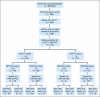
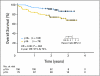
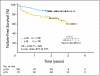
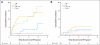
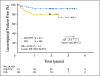
Slides were available for p16 assay in 206 of 465 patients, of which 185 were eligible, and p16 and HPV were evaluable in 172 patients. One hundred six (57%) of 185 were p16-positive, and in patients evaluable for both p16 and HPV, 88 (86%) of 102 p16-positive patients were also HPV-positive. Patients who were p16-positive had lower T and higher N categories and better Eastern Cooperative Oncology Group (ECOG) performance status. p16-positive tumors compared with p16-negative tumors were associated with better 2-year overall survival (91% v 74%; hazard ratio [HR], 0.36; 95% CI, 0.17 to 0.74; P = .004) and failure-free survival (87% v 72%; HR, 0.39; 95% CI, 0.20 to 0.74; P = .003). p16 was a significant prognostic factor on multivariable analysis (HR, 0.45; 95% CI, 0.21 to 0.96; P = .04). p16-positive patients had lower rates of locoregional failure and deaths due to other causes. There was a trend favoring the tirapazamine arm for improved locoregional control in p16-negative patients (HR, 0.33; 95% CI, 0.09 to 1.24; P = .13).
Conclusion:
HPV-associated oropharyngeal cancer is a distinct entity with a favorable prognosis compared with HPV-negative oropharyngeal cancer when treated with cisplatin-based chemoradiotherapy.
Failure-free survival by p16 status. HR, hazard ratio.
Fig 3.
Failure-free survival by p16 status. HR, hazard ratio.
Fig 4.
Cumulative incidence curves of site…
Fig 4.
Cumulative incidence curves of site of first failure by p16 status for (A)…
Fig 4.
Cumulative incidence curves of site of first failure by p16 status for (A) p16-negative and (B) p16-positive patients. LRF, locoregional failure; DF, distant failure; RT, radiotherapy.
Fig 5.
Time to locoregional failure by…
Fig 5.
Time to locoregional failure by treatment arm. CIS, cisplatin; TPZ, tirapazamine; HR, hazard…
Fig 5.
Time to locoregional failure by treatment arm. CIS, cisplatin; TPZ, tirapazamine; HR, hazard ratio; OS, overall survival.
Gillison ML, Koch WM, Capone RB, et al. Evidence for a causal association between human papillomavirus and a subset of head and neck cancers. J Natl Cancer Inst. 2000;92:709–720.
-
PubMed
Chaturvedi AK, Engels EA, Anderson WF, et al. Incidence trends for human papillomavirus-related and -unrelated oral squamous cell carcinomas in the United States. J Clin Oncol. 2008;26:612–619.
-
PubMed
Näsman A, Attner P, Hammarstedt L, et al. Incidence of human papillomavirus (HPV) positive tonsillar carcinoma in Stockholm, Sweden: An epidemic of viral-induced carcinoma? Int J Cancer. 2009;125:362–366.
-
PubMed
Herrero R, Castellsagué X, Pawlita M, et al. Human papillomavirus and oral cancer: The International Agency for Research on Cancer multicenter study. J Natl Cancer Inst. 2003;95:1772–1783.
-
PubMed
Gillison ML, D'Souza G, Westra W, et al. Distinct risk factor profiles for human papillomavirus type 16-positive and human papillomavirus type 16-negative head and neck cancers. J Natl Cancer Inst. 2008;100:407–420.
-
PubMed