The current decrease of new drugs brought to the market has fostered renewed interest in plant-based drug discovery. Given the alarming rate of biodiversity loss, systematic methodologies in finding new plant-derived drugs are urgently needed. Medicinal uses of plants were proposed as proxy for bioactivity, and phylogenetic patterns in medicinal plant uses have suggested that phylogeny can be used as predictive tool. However, the common practice of grouping medicinal plant uses into standardised categories may restrict the relevance of phylogenetic predictions. Standardised categories are mostly associated to systems of the human body and only poorly reflect biological responses to the treatment. Here we show that medicinal plant uses interpreted from a perspective of a biological response can reveal different phylogenetic patterns of presumed underlying bioactivity compared to standardised methods of medicinal plant use classification. In the cosmopolitan and pharmaceutically highly relevant genus Euphorbia L., identifying plant uses modulating the inflammatory response highlighted a greater phylogenetic diversity and number of potentially promising species than standardised categories. Our interpretation of medicinal plant uses may therefore allow for a more targeted approach for future phylogeny-guided drug discovery at an early screening stage, which will likely result in higher discovery rates of novel chemistry with functional biological activity.
The authors declare no competing financial interests.
Figures
Figure 1. Hypothetical distribution of medicinal plant…
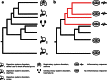
Figure 1. Hypothetical distribution of medicinal plant uses across a phylogeny.
( a) Plant medicinal…
Figure 1. Hypothetical distribution of medicinal plant uses across a phylogeny.
(a) Plant medicinal uses as classified by the Economic Botany Data Collection Standard based on systems of the body (b) Same plant medicinal uses classified based on a biological response. When seeking lineages with potential agents modulating an inflammatory response, the classification in (a) is not informative. Instead, the classification in (b) allows us to identify clades (marked in red in (b)) that are overrepresented in species potentially modulating an inflammatory response. Icons: thenounproject.com.
Figure 2
Phylogenetic distribution of species for…
Figure 2
Phylogenetic distribution of species for ( a ) the Economic Botany Data Collection…
Figure 2
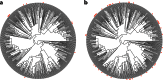
Phylogenetic distribution of species for (a) the Economic Botany Data Collection Standard (EBDCS) category inflammation and (b) the category inflammatory response. Red dots indicate species with documented use described in the category.
Figure 3. Hot nodes and corresponding clades…
Figure 3. Hot nodes and corresponding clades of the category inflammatory response .
Hot nodes (red…
Figure 3. Hot nodes and corresponding clades of the category inflammatory response.
Hot nodes (red dots) were identified by the nodesigl command in PHYLOCOM v4.2 on the majority consensus tree. Hot nodes indicate that the observed number of species in the category in that node is higher than expected by chance. Black dots indicate species with documented uses in the category inflammatory response. Photo: Mogens Trolle and Madeleine Ernst (Euphorbia pulcherrima).
Newman D. J., Cragg G. M. & Snader K. M. The influence of natural products upon drug discovery. Nat. Prod. Rep. 17, 215–234 (2000).
-
PubMed
Cragg G. M. & Newman D. J. Natural products: A continuing source of novel drug leads. Biochim. Biophys. Acta 1830, 3670–3695 (2013).
-
PMC
-
PubMed
Plants under pressure – a global assessment. IUCN Sampled Red List Index for Plants (Royal Botanic Gardens, Kew, UK, 2012).
Dahlgren R. M. T. A revised system of classification of the angiosperms. Bot. J. Linn. Soc. 80, 91–124 (1980).
Gottlieb O. R. Ethnopharmacology versus chemosytematics in the search for biologically active principles in plants. J. Ethnopharmacol. 6, 227–238 (1982).
-
PubMed