Savelyev A, Jeong C.Savelyev A, et al.Evol Hum Sci. 2022 Mar 10;4:e8. doi: 10.1017/ehs.2022.8. eCollection 2022.Evol Hum Sci. 2022.PMID: 37588906Free PMC article.
Abstract
The origin of the Xiongnu and the Rourans, the nomadic groups that dominated the eastern Eurasian steppe in the late first millennium BC/early first millennium AD, is one of the most controversial topics in the early history of Inner Asia. As debatable is the evidence linking these two groups with the steppe nomads of early medieval Europe, i.e. the Huns and the Avars, respectively. In this paper, we address the problems of Xiongnu-Hun and Rouran-Avar connections from an interdisciplinary perspective, complementing current archaeological and historical research with a critical analysis of the available evidence from historical linguistics and population genetics. Both lines of research suggest a mixed origin of the Xiongnu population, consisting of eastern and western Eurasian substrata, and emphasize the lack of unambiguous evidence for a continuity between the Xiongnu and the European Huns. In parallel, both disciplines suggest that at least some of the European Avars were of Eastern Asian ancestry, but neither linguistic nor genetic evidence provides a sufficient support for a specific connection between the Avars and the Asian Rourans.
Keywords:
Avars; History of the Steppe; Huns; Rourans; Xiongnu.
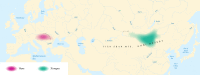
The Xiongnu steppe empire and the heartland of the European Huns.
Figure 1.
The Xiongnu steppe empire and the heartland of the European Huns.
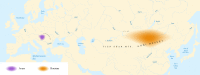
Figure 2.
The Rouran steppe empire and…
Figure 2.
The Rouran steppe empire and the heartland of the European Avars.
Figure 2.
The Rouran steppe empire and the heartland of the European Avars.
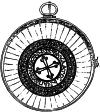
Figure 3.
The Buila inscription from the…
Figure 3.
The Buila inscription from the Treasure of Nagyszentmiklós (reproduced from Hampel, 1894).
Figure 3.
The Buila inscription from the Treasure of Nagyszentmiklós (reproduced from Hampel, 1894).
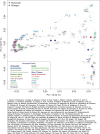
Figure 4.
The genetic affinity of the…
Figure 4.
The genetic affinity of the Xiongnu- and Rouran-period individuals with present-day Eurasian populations.…
Figure 4.
The genetic affinity of the Xiongnu- and Rouran-period individuals with present-day Eurasian populations. We present the first two principal components calculated for 2077 present-day Eurasian individuals and project the ancient individuals on top of it. The Rouran-period individual falls between present-day Mongolic-speaking populations from southern Siberia and Tungusic- and Nivkh-speaking ones from the lower Amur river basin. Each grey dot represents a present-day individual, and the coloured numbers represent the average coordinates of the populations, coloured by their language family. Population IDs corresponding to the numbers are provided at the bottom of the plot. Data are sourced from previous publications (Damgaard et al., ; Jeong et al., ; Li et al., 2018).
Allentoft, M. E., Sikora, M., Sjogren, K. G., Rasmussen, S., Rasmussen, M., Stenderup J., Willerslev …, E. (2015). Population genomics of Bronze Age Eurasia. Nature, 522, 161–172.
-
PubMed
Atwood, C. P. (2012). Huns and Xiōngnú: New thoughts on an old problem. In Boeck B. J., Martin R. E., & Rowland D. (Eds.), Dubitando: Studies in history and culture in honor of Donald Ostrowski (pp. 27–52). Slavica.
Bailey, H. W. (1985). Indo-Scythian studies, being Khotanese texts, VII. Cambridge University Press.
Baxter, W. H., & Sagart, L. (2011). Old Chinese: A new reconstruction. Oxford University Press.
Bazin, L. (1948). Un texte proto-turc du IVe siecle: le distique hiong-nou du ‘Tsin-chou’. Oriens, 1(2), 208–219.