Bounded operator
From Wikipedia, the free encyclopedia
In functional analysis and operator theory, a bounded linear operator is a special kind of linear transformation that is particularly important in infinite dimensions. In finite dimensions, a linear transformation takes a bounded set to another bounded set (for example, a rectangle in the plane goes either to a parallelogram or bounded line segment when a linear transformation is applied). However, in infinite dimensions, linearity is not enough to ensure that bounded sets remain bounded: a bounded linear operator is thus a linear transformation that sends bounded sets to bounded sets.
Formally, it is a linear transformation between topological vector spaces (TVSs) and that maps bounded subsets of to bounded subsets of If and are normed vector spaces (a special type of TVS), then is bounded if and only if there exists some such that for all The infimum such is called the operator norm of and denoted by A linear operator between normed spaces is continuous if and only if it is bounded.





The concept of a bounded linear operator has been extended from normed spaces to all topological vector spaces.
Outside of functional analysis, when a function is called "bounded" then this usually means that its image is a bounded subset of its codomain. A linear map has this property if and only if it is identically Consequently, in functional analysis, when a linear operator is called "bounded" then it is never meant in this abstract sense (of having a bounded image).


In normed vector spaces
[edit]
Every bounded operator is Lipschitz continuous at
Equivalence of boundedness and continuity
[edit]
A linear operator between normed spaces is bounded if and only if it is continuous.
Relative boundedness
[edit]
Given two partially defined linear operators , we say that is relatively bounded by (or that is -bounded), iff , and there exists , such thatThe infimum of all such is the relative -bound of .[1]


Since Hilbert spaces are complete normed spaces with the norm induced by the inner product, the previous applies here as well. Notably, the space of bounded linear operators on a Hilbert space H becomes a C*-algebra and especially an operator space. It is possible to define various different notions of boundedness for an operator T.

For example, T is called power bounded if for all natural numbers n. This condition implies that T is bounded, of course, but the converse need not be true.

Another boundedness condition is that of polynomial boundedness: an operator T on L(H) is polynomially bounded if there exists a positive constant (that depends only on T) such thatfor all (analytic) polynomials p that are defined on the closed unit disk . Again this condition implies power boundedness and norm boundedness, but the converse need not be true.


Furthermore, an operator is called completely polynomially bounded if there exists a positive constant K such thatfor all matrices of (analytic) polynomials and for all natural numbers n. Here, the respective matrix norms are naturally induced by the structure of the space of matrices and can be understood as the polynomial functional calculus. Every completely polynomially bounded operator is polynomially- and power bounded, as well as norm bounded, but the opposite does not hold in general.


Positive examples of completely polynomially bounded operators are contractive operators T,[2] namely those for whichholds true.

In topological vector spaces
[edit]
A linear operator between two topological vector spaces (TVSs) is called a bounded linear operator or just bounded if whenever is bounded in then is bounded in A subset of a TVS is called bounded (or more precisely, von Neumann bounded) if every neighborhood of the origin absorbs it. In a normed space (and even in a seminormed space), a subset is von Neumann bounded if and only if it is norm bounded. Hence, for normed spaces, the notion of a von Neumann bounded set is identical to the usual notion of a norm-bounded subset.


Continuity and boundedness
[edit]
Every sequentially continuous linear operator between TVS is a bounded operator.[3] This implies that every continuous linear operator between metrizable TVS is bounded. However, in general, a bounded linear operator between two TVSs need not be continuous.
This formulation allows one to define bounded operators between general topological vector spaces as an operator which takes bounded sets to bounded sets. In this context, it is still true that every continuous map is bounded, however the converse fails; a bounded operator need not be continuous. This also means that boundedness is no longer equivalent to Lipschitz continuity in this context.
If the domain is a bornological space (for example, a pseudometrizable TVS, a Fréchet space, a normed space) then a linear operators into any other locally convex spaces is bounded if and only if it is continuous. For LF spaces, a weaker converse holds; any bounded linear map from an LF space is sequentially continuous.
If is a linear operator between two topological vector spaces and if there exists a neighborhood of the origin in such that is a bounded subset of then is continuous.[4] This fact is often summarized by saying that a linear operator that is bounded on some neighborhood of the origin is necessarily continuous. In particular, any linear functional that is bounded on some neighborhood of the origin is continuous (even if its domain is not a normed space).


Bornological spaces
[edit]
Bornological spaces are exactly those locally convex spaces for which every bounded linear operator into another locally convex space is necessarily continuous. That is, a locally convex TVS is a bornological space if and only if for every locally convex TVS a linear operator is continuous if and only if it is bounded.[5]
Every normed space is bornological.
Characterizations of bounded linear operators
[edit]
Let be a linear operator between topological vector spaces (not necessarily Hausdorff). The following are equivalent:
- is (locally) bounded;[5]
- (Definition): maps bounded subsets of its domain to bounded subsets of its codomain;[5]
- maps bounded subsets of its domain to bounded subsets of its image ;[5]
- maps every null sequence to a bounded sequence;[5]
- A null sequence is by definition a sequence that converges to the origin.
- Thus any linear map that is sequentially continuous at the origin is necessarily a bounded linear map.
- maps every Mackey convergent null sequence to a bounded subset of [note 1]
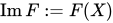
if and are locally convex then the following may be add to this list:
- maps bounded disks into bounded disks.[6]
- maps bornivorous disks in into bornivorous disks in [6]


if is a bornological space and is locally convex then the following may be added to this list:
- is sequentially continuous at some (or equivalently, at every) point of its domain.[7]
- is sequentially continuous at the origin.
Unbounded linear operators
[edit]
Let be the space of all trigonometric polynomials on with the norm
![{\displaystyle [-\pi ,\pi ],}](https://wikimedia.org/api/rest_v1/media/math/render/svg/7d9f0d54c7944ecc029624a4317a7aee63b3ee14)
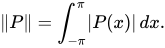
The operator that maps a polynomial to its derivative is not bounded. Indeed, for with we have while as so is not bounded.






Properties of the space of bounded linear operators
[edit]
The space of all bounded linear operators from to is denoted by .

- Bounded set (topological vector space) – Generalization of boundedness
- Contraction (operator theory) – Bounded operators with sub-unit norm
- Discontinuous linear map
- Continuous linear operator – Function between topological vector spaces
- Local boundedness
- Norm (mathematics) – Length in a vector space
- Operator algebra – Branch of functional analysis
- Operator norm – Measure of the "size" of linear operators
- Operator theory – Mathematical study of linear operators
- Seminorm – Mathematical function
- Unbounded operator – Linear operator defined on a dense linear subspace
- ^ Mortad, Mohammed Hichem (2022), Mortad, Mohammed Hichem (ed.), "Relative Boundedness", Counterexamples in Operator Theory, Cham: Springer International Publishing, pp. 553–566, doi:10.1007/978-3-030-97814-3_31, ISBN 978-3-030-97814-3
{{citation}}: CS1 maint: work parameter with ISBN (link) - ^ Paulsen, Vern, ed. (2003), "Completely Positive Maps", Completely Bounded Maps and Operator Algebras, Cambridge Studies in Advanced Mathematics, Cambridge: Cambridge University Press, pp. 26–42, doi:10.1017/cbo9780511546631.004, ISBN 978-0-521-81669-4, retrieved 2025-08-03
{{citation}}: CS1 maint: work parameter with ISBN (link) - ^ a b Wilansky 2013, pp. 47–50.
- ^ Narici & Beckenstein 2011, pp. 156–175.
- ^ a b c d e Narici & Beckenstein 2011, pp. 441–457.
- ^ a b Narici & Beckenstein 2011, p. 444.
- ^ Narici & Beckenstein 2011, pp. 451–457.
- "Bounded operator", Encyclopedia of Mathematics, EMS Press, 2001 [1994]
- Kreyszig, Erwin: Introductory Functional Analysis with Applications, Wiley, 1989
- Narici, Lawrence; Beckenstein, Edward (2011). Topological Vector Spaces. Pure and applied mathematics (Second ed.). Boca Raton, FL: CRC Press. ISBN 978-1584888666. OCLC 144216834.
- Wilansky, Albert (2013). Modern Methods in Topological Vector Spaces. Mineola, New York: Dover Publications, Inc. ISBN 978-0-486-49353-4. OCLC 849801114.