Alternating Sign Matrix
An alternating sign matrix is a matrix of 0s, 1s, and  s
in which the entries in each row or column sum to 1 and the nonzero entries in each
row and column alternate in sign. The first few for
s
in which the entries in each row or column sum to 1 and the nonzero entries in each
row and column alternate in sign. The first few for  , 2, ... are shown below:
Such matrices satisfy the additional property that  s in a row or column must have a
  "outside" it (i.e., all
  s are "bordered" by
  s). The numbers of
  alternating sign matrices
  for
for  , 2, ... are given by 1, 2, 7, 42, 429, 7436, 218348, ...
(OEIS A005130).
, 2, ... are given by 1, 2, 7, 42, 429, 7436, 218348, ...
(OEIS A005130).
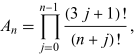
The conjecture that the number  of
of  is explicitly given by the formula
 |
(5) |
now proven to be true, was known as the alternating sign matrix conjecture.  can be expressed in closed form as a complicated function
of Barnes G-functions, but additional simplification
is likely possible.
can be expressed in closed form as a complicated function
of Barnes G-functions, but additional simplification
is likely possible.
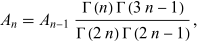
A recurrence relation for  is given by
 |
(6) |
where  is the gamma function.
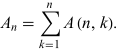
Let  be the number of
  alternating sign matrices with one in the top row occurring
in the
alternating sign matrices with one in the top row occurring
in the  th
position. Then
th
position. Then
 |
(7) |
The result
 |
(8) |
for  implies (7) (Mills et al. 1983).
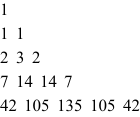
Making a triangular array of the number of  with a 1 at the top of column
  gives
gives
 |
(9) |
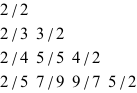
(OEIS A048601), and taking the ratios of adjacent terms gives the array
 |
(10) |
(OEIS A029656 and A029638). The fact that these numerators and denominators are respectively the numbers in the (2, 1)- and (1, 2)-Pascal triangles which are different from 1 is known as the refined alternating sign matrix conjecture.
See also
Alternating Sign Matrix Conjecture, Condensation, Descending Plane Partition, Integer Matrix, Permutation Matrix
Explore with Wolfram|Alpha
References
Andrews, G. E. "Plane Partitions (III): The Weak Macdonald Conjecture." Invent. Math. 53, 193-225, 1979.Bressoud, D. Proofs and Confirmations: The Story of the Alternating Sign Matrix Conjecture. Cambridge, England: Cambridge University Press, 1999.Bressoud, D. and Propp, J. "How the Alternating Sign Matrix Conjecture was Solved." Not. Amer. Math. Soc. 46, 637-646.Finch, S. R. Mathematical Constants. Cambridge, England: Cambridge University Press, p. 413, 2003.Kuperberg, G. "Another Proof of the Alternating-Sign Matrix Conjecture." Internat. Math. Res. Notes, No. 3, 139-150, 1996.Mills, W. H.; Robbins, D. P.; and Rumsey, H. Jr. "Proof of the Macdonald Conjecture." Invent. Math. 66, 73-87, 1982.Mills, W. H.; Robbins, D. P.; and Rumsey, H. Jr. "Alternating Sign Matrices and Descending Plane Partitions." J. Combin. Th. Ser. A 34, 340-359, 1983.Pickover, C. A. "Princeton Numbers." Ch. 79 in Wonders of Numbers: Adventures in Mathematics, Mind, and Meaning. Oxford, England: Oxford University Press, pp. 189-192, 2001.Robbins, D. P. "The Story of 1, 2, 7, 42, 429, 7436, ...." Math. Intell. 13, 12-19, 1991.Robbins, D. P. and Rumsey, H. Jr. "Determinants and Alternating Sign Matrices." Adv. Math. 62, 169-184, 1986.Sloane, N. J. A. Sequences A005130/M1808, A029638, A029656, A048601, and A050204 in "The On-Line Encyclopedia of Integer Sequences."Stanley, R. P. "A Baker's Dozen of Conjectures Concerning Plane Partitions." In Combinatoire Énumérative. Proceedings of the colloquium held at the Université du Québec, Montreal, May 28-June 1, 1985 (Ed. G. Labelle and P. Leroux). New York: Springer-Verlag, pp. 285-293, 1986.Zeilberger, D. "A Constant Term Identity Featuring the Ubiquitous (and Mysterious) Andrews-Mills-Robbins-Rumsey numbers 1, 2, 7, 42, 429, ...." J. Combin. Theory A 66, 17-27, 1994.Zeilberger, D. "Proof of the Alternating Sign Matrix Conjecture." Elec. J. Combin. 3, No. 2, R13, 1-84, 1996. https://doi.org/10.37236/1271.Zeilberger, D. "Proof of the Refined Alternating Sign Matrix Conjecture." New York J. Math. 2, 59-68, 1996.
Referenced on Wolfram|Alpha
Cite this as:
Weisstein, Eric W. "Alternating Sign Matrix." From MathWorld--A Wolfram Resource. https://mathworld.wolfram.com/AlternatingSignMatrix.html