Exponential Function
The most general form of "an" exponential function is a power-law function of the form
 |
(1) |
where  ,
,
 ,
and
,
and  are real numbers,
  is a positive real number, and
  is a real variable. When
  is positive,
  is an exponentially
increasing function and when
is an exponentially
increasing function and when  is negative,
  is an exponentially
decreasing function.
is an exponentially
decreasing function.
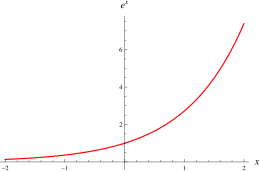
In contrast, "the" exponential function (in elementary contexts sometimes called the "natural exponential function") is the function defined by
 |
(2) |
where e is positive real number  is the base of the natural
logarithm. The function
is the base of the natural
logarithm. The function  is also the unique solution of the differential
equation
is also the unique solution of the differential
equation  with initial condition
  . In other words, the exponential function is its own
derivative, so
. In other words, the exponential function is its own
derivative, so
 |
(3) |
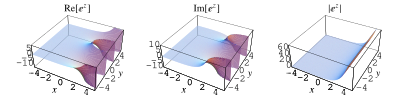
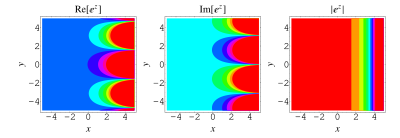
The exponential function  defined for complex variable
  is an entire function in
the complex plane.
is an entire function in
the complex plane.
The exponential function is implemented in the Wolfram Language as Exp[z].
The "natural" and general exponential functions are related to one another by a simple scalings of the variable  and multiplicative prefactors via the identity
 |
(4) |
where  is the natural logarithm.
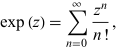
The exponential function has the simple Maclaurin series
 |
(5) |
where  is a factorial, and satisfies the limit
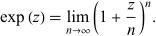 |
(6) |
The exponential function satisfies the identity
 |
(7) |
It is also related to trigonometric functions via the identities
where  is the Gudermannian (Beyer 1987, p. 164; Zwillinger
1995, p. 485).
is the Gudermannian (Beyer 1987, p. 164; Zwillinger
1995, p. 485).
If  ,
,
 |
(12) |
Similarly, if
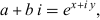 |
(13) |
then
The exponential function has continued fraction
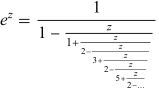 |
(17) |
(Wall 1948, p. 348).
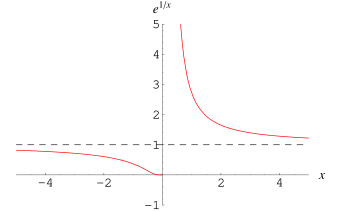
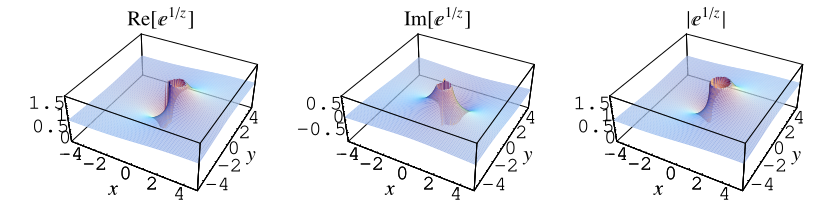
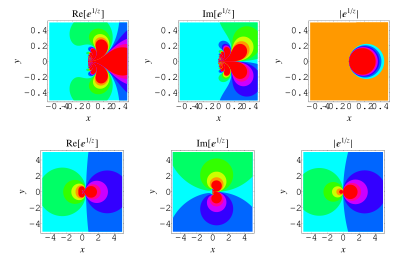
The above plot shows the function  (Trott 2004, pp. 165-166).
Integrals involving the exponential function include
(Borwein et al. 2004, p. 55).
See also
Cis, Complex Exponentiation, e, Euler Formula, Exponent, Exponent Laws, Exponential Decay, Exponential Growth, Exponential Ramp, Exponentially Decreasing Function, Exponentially Increasing Function, Fourier Transform--Exponential Function, Gudermannian, Natural Exponential Function, Phasor, Power, Sigmoid Function Explore this topic in the MathWorld classroom
Related Wolfram sites
https://functions.wolfram.com/ElementaryFunctions/Exp/
Explore with Wolfram|Alpha
References
Abramowitz, M. and Stegun, I. A. (Eds.). "Exponential Function." §4.2 in Handbook
of Mathematical Functions with Formulas, Graphs, and Mathematical Tables, 9th printing.
New York: Dover, pp. 69-71, 1972.Beyer, W. H. CRC
Standard Mathematical Tables, 28th ed. Boca Raton, FL: CRC Press, p. 217,
1987.Borwein, J.; Bailey, D.; and Girgensohn, R. Experimentation
in Mathematics: Computational Paths to Discovery. Wellesley, MA: A K Peters,
2004.Finch, S. "Linear Independence of Exponential Functions."
https://web.archive.org/web/20080601064209/http://algo.inria.fr:80/csolve/sstein.html.Fischer,
G. (Ed.). Plates 127-128 in Mathematische
Modelle aus den Sammlungen von Universitäten und Museen, Bildband. Braunschweig,
Germany: Vieweg, pp. 124-125, 1986.Krantz, S. G. "The
Exponential and Applications." §1.2 in Handbook
of Complex Variables. Boston, MA: Birkhäuser, pp. 7-12, 1999.Spanier,
J. and Oldham, K. B. "The Exponential Function  " and "Exponentials of Powers
  ." Chs. 26-27 in An
Atlas of Functions. Washington, DC: Hemisphere, pp. 233-261, 1987.Trott,
M. "Elementary Transcendental Functions." §2.2.3 in The
Mathematica GuideBook for Programming. New York: Springer-Verlag, 2004. https://www.mathematicaguidebooks.org/.Wall,
H. S. Analytic
Theory of Continued Fractions. New York: Chelsea, 1948.Yates,
R. C. "Exponential Curves." A
Handbook on Curves and Their Properties. Ann Arbor, MI: J. W. Edwards,
pp. 86-97, 1952.Zwillinger, D. (Ed.). CRC
Standard Mathematical Tables and Formulae. Boca Raton, FL: CRC Press, 1995.
." Chs. 26-27 in An
Atlas of Functions. Washington, DC: Hemisphere, pp. 233-261, 1987.Trott,
M. "Elementary Transcendental Functions." §2.2.3 in The
Mathematica GuideBook for Programming. New York: Springer-Verlag, 2004. https://www.mathematicaguidebooks.org/.Wall,
H. S. Analytic
Theory of Continued Fractions. New York: Chelsea, 1948.Yates,
R. C. "Exponential Curves." A
Handbook on Curves and Their Properties. Ann Arbor, MI: J. W. Edwards,
pp. 86-97, 1952.Zwillinger, D. (Ed.). CRC
Standard Mathematical Tables and Formulae. Boca Raton, FL: CRC Press, 1995.
Referenced on Wolfram|Alpha
Cite this as:
Weisstein, Eric W. "Exponential Function." From MathWorld--A Wolfram Resource. https://mathworld.wolfram.com/ExponentialFunction.html