Minimum
The smallest value of a set, function, etc. The minimum value of a set of elements  is denoted
  or
or  ,
and is equal to the first element of a sorted (i.e., ordered) version of
,
and is equal to the first element of a sorted (i.e., ordered) version of  . For example, given the set
  , the sorted version is
  , so the minimum is 1. The maximum
and minimum are the simplest order statistics.
, so the minimum is 1. The maximum
and minimum are the simplest order statistics.
The minimum value of a variable  is commonly denoted
  (cf. Strang 1988, pp. 286-287 and 301-303) or
  (Golub and Van Loan 1996, p. 84).
In this work, the convention
(Golub and Van Loan 1996, p. 84).
In this work, the convention  is used.
The minimum of a set of elements is implemented in the Wolfram Language as Min[list] and satisfies the identities
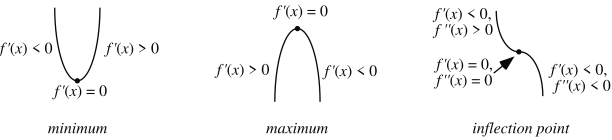
A continuous function may assume a minimum at a single point or may have minima at a number of points. A global minimum of a function is the smallest value in the entire range of the function, while a local minimum is the smallest value in some local neighborhood.
For a function  which is continuous at a point
  , a necessary but not sufficient
condition for
, a necessary but not sufficient
condition for  to have a local minimum at
  is that
  be a critical point (i.e.,
 is either not differentiable
at
is either not differentiable
at  or
or  is a stationary point,
in which case
is a stationary point,
in which case  ).
).
The first derivative test can be applied to continuous functions to distinguish minima
from maxima. For twice differentiable functions of one
variable,  ,
or of two variables,
,
or of two variables,  ,
the second derivative test can sometimes
also identify the nature of an extremum. For a function
,
the second derivative test can sometimes
also identify the nature of an extremum. For a function
 , the extremum
test succeeds under more general conditions than the second
derivative test.
, the extremum
test succeeds under more general conditions than the second
derivative test.
Definite integral include
See also
Conjugate Gradient Method, Critical Point, Extremum, First Derivative Test, Global Maximum, Inflection Point, Local Maximum, Maximum, Method of Steepest Descent, Midrange, Order Statistic, Saddle Point, Second Derivative Test, Stationary Point Explore this topic in the MathWorld classroom
Related Wolfram sites
https://functions.wolfram.com/ElementaryFunctions/Min/
Explore with Wolfram|Alpha
References
Abramowitz, M. and Stegun, I. A. (Eds.). Handbook of Mathematical Functions with Formulas, Graphs, and Mathematical Tables, 9th printing. New York: Dover, p. 14, 1972.Brent, R. P. Algorithms for Minimization Without Derivatives. Englewood Cliffs, NJ: Prentice-Hall, 1973.Golub, G. and Van Loan, C. Matrix Computations, 3rd ed. Baltimore, MD: Johns Hopkins University Press, 1996.Nash, J. C. "Descent to a Minimum I-II: Variable Metric Algorithms." Chs. 15-16 in Compact Numerical Methods for Computers: Linear Algebra and Function Minimisation, 2nd ed. Bristol, England: Adam Hilger, pp. 186-206, 1990.Niven, I. Maxima and Minima without Calculus. Washington, DC: Math. Assoc. Amer., 1982.Press, W. H.; Flannery, B. P.; Teukolsky, S. A.; and Vetterling, W. T. "Minimization or Maximization of Functions." Ch. 10 in Numerical Recipes in FORTRAN: The Art of Scientific Computing, 2nd ed. Cambridge, England: Cambridge University Press, pp. 387-448, 1992.Strang, G. Linear Algebra and its Applications, 3rd ed. Philadelphia, PA: Saunders, 1988.Tikhomirov, V. M. Stories About Maxima and Minima. Providence, RI: Amer. Math. Soc., 1991.
Referenced on Wolfram|Alpha
Cite this as:
Weisstein, Eric W. "Minimum." From MathWorld--A Wolfram Resource. https://mathworld.wolfram.com/Minimum.html