Vector Addition
Vector addition is the operation of adding two or more vectors together into a vector sum.
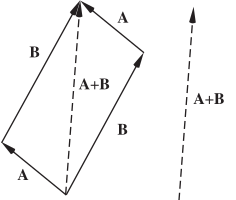
The so-called parallelogram law gives the rule for vector addition of two or more vectors. For two vectors  and
and  , the vector sum
  is obtained by placing them head to tail and drawing the
vector from the free tail to the free head. In Cartesian
coordinates, vector addition can be performed simply by adding the corresponding
components of the vectors, so if
is obtained by placing them head to tail and drawing the
vector from the free tail to the free head. In Cartesian
coordinates, vector addition can be performed simply by adding the corresponding
components of the vectors, so if  and
and  ,
,

Vector addition is indicated in the Wolfram Language using a plus sign, e.g.,  a1, a2, ..., an
 +
+ b1,
b2, ..., bn
b1,
b2, ..., bn .
.
See also
Complex Addition, Cross Product, Dot Product, Parallelogram Law, Scalar Multiplication, Vector, Vector Difference, Vector Multiplication, Vector Subtraction, Vector Sum
Explore with Wolfram|Alpha
Cite this as:
Weisstein, Eric W. "Vector Addition." From MathWorld--A Wolfram Resource. https://mathworld.wolfram.com/VectorAddition.html