COLING 2016 Workshop on Noisy User-generated Text (W-NUT)
December 11 2016, Osaka, Japan (last year at ACL)
We have received 27 main workshop submissions! We look forward to seeing you at COLING!
Best papers:
Veracity Computing from Lexical Cues and Perceived Certainty Trends
Uwe Reichel and Piroska Lendvai
Name Variation in Community Question Answering Systems
Anietie Andy, Satoshi Sekine, Mugizi Rwebangira and Mark Dredze
NEW! WNUT 2017 will be co-located with EMNLP!
WNUT focuses on Natural Language Processing applied to noisy user-generated text, such as that found in social media, web forums, online reviews, clinical records and language learner essays. This year, there will be two shared tasks: 1) Geolocation Prediction in Twitter and 2) Named Entity Recognition in Twitter.
Time: 9:00-17:00
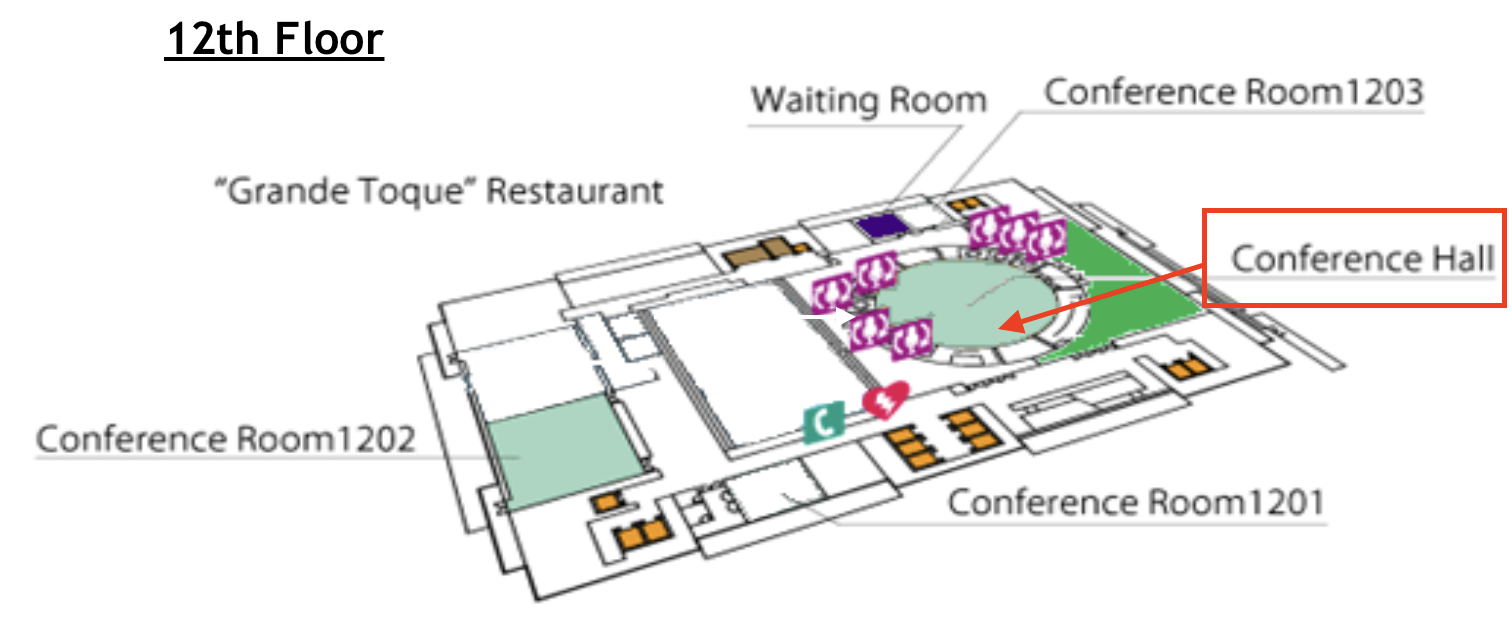
Location:
Workshop Organizers
- Bo Han (Hugo AI)
- Alan Ritter (The Ohio State University)
- Leon Derczynski (The University of Sheffield)
- Wei Xu (The Ohio State University)
- Tim Baldwin (The University of Melbourne)
Invited Speakers
-
Ming-Wei Chang (Microsoft Research)
From Entity Linking to Question Answering – Recent Progress on Semantic Grounding Tasks -
Barbara Plank (University of Groningen)
Processing non-canonical or noisy text: fortuitous data to the rescue -
Kentaro Torisawa (National Institute of Information and Communications Technology)
DISAANA and D-SUMM: Large-scale Real Time NLP Systems for Analyzing Disaster Related Reports in Tweets
Program
For posters, COLING provides: A self-standing poster panel measuring 180 cm wide and 210 cm high. Sizes up to B0 landscape (1456 mm x 1030 mm; 57.32 inch x 40.55 inch) would be suitable.
Important Dates
- July 6 2016: First call for workshop papers
- September 2016: Shared-task evaluations
- October 2
September 252016: Workshop paper due (extended due to author requests) - October 19
October 16, 2016: Notification of acceptance - October 30, 2016: Camera-ready due
- November 30, 2016: Official proceedings publication date
- December 11, 2016: Workshop date
Call for Papers
We seek submissions of regular papers on original and unpublished work (same 8-page limit plus 2-page reference as COLING main conference). 1-page abstracts on work-in-progress or work published elsewhere are also welcome and will *not* be included in the conference proceedings.
All accepted submissions will be presented as posters. Additionally, selected submissions will be presented orally. The shared-task participants are also encouraged (but not required) to submit system description papers and present posters; the top systems will be invited (but not required) to present orally.
Topics of interest include but are not limited to:
- NLP Preprocessing of Noisy Text
- Part of speech tagging
- Named entity tagging, including a wide range of categories, e.g. product names
- Chunking of user-generated text
- Parsing
- Text Normalization and Error Correction
- Normalizing noisy text for downstream tasks and for human readability
- Error detection and correction
- Paraphrase identification and semantic similarity of short text or noisy text
- User prediction, e.g. geolocation, gender, age, etc
- Bilingual translation of noisy text
- Information extraction from noisy text
- Multilingual NLP in noisy text
- Colloquial language, e.g. idiom detection
- Domain adaptation to user-generated text
- Geolocation prediction
- Global and regional trend detection and event extraction
- Extracting user demographics, profiles and major life events
- Detecting rumors, contradictory information, sarcasms and humors on social media
- Sentiment analysis
- Temporal aspects of user-generated content (resolving time expressions, concept drift, diachronic analyses, etc...)
All submissions should conform to COLING 2016 style guidelines. Long and short paper submissions must be anonymized. Abstract submissions should include author information (and where the work was published in a footnote on front page, if applicable). Please submit your papers at https://www.softconf.com/coling2016/WNUT/.
Shared task #1: Geolocation Prediction in Twitter
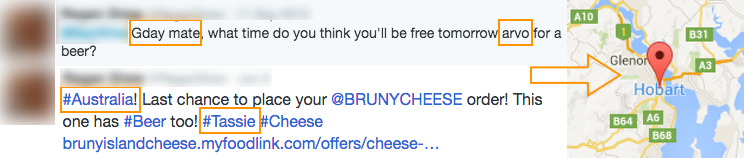
This new shared task focuses on the prediction of geolocation on the basis of text data (including Twitter metadata).
Task #1 Details
Registration: here
Evaluation Period: 18 September 2016
Contacts: Afshin Rahimi, Bo Han, Leon Derczynski and Tim Baldwin
Shared task #2: Named Entity Recognition in Twitter
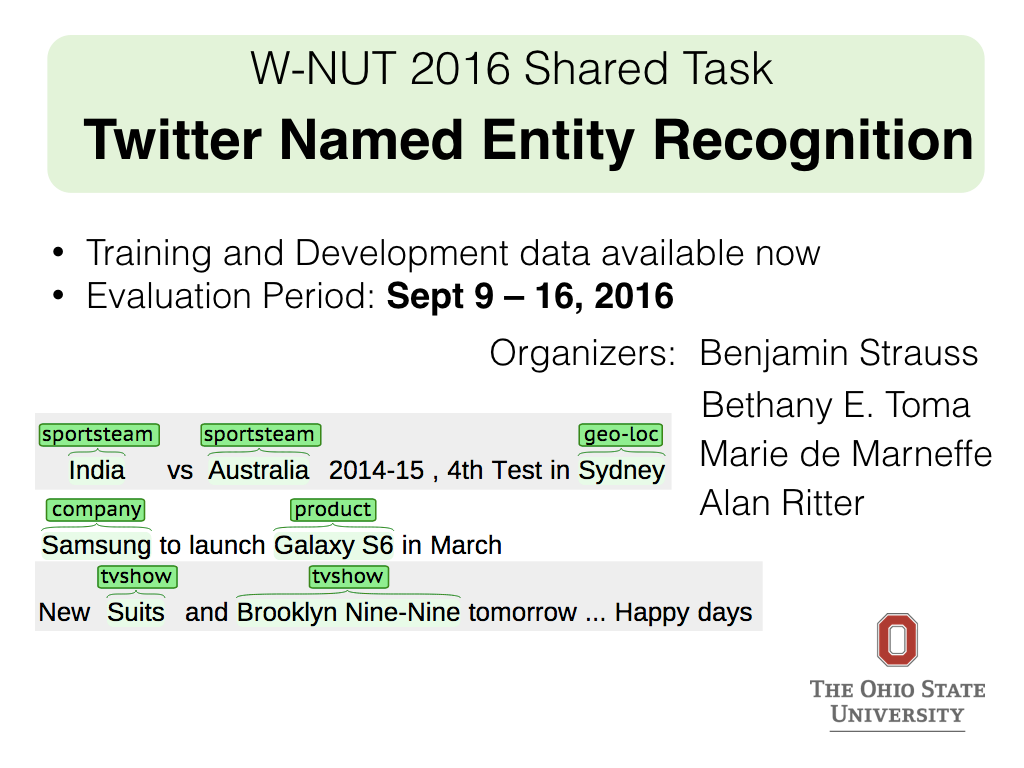
Task #2 Details
Registration: click here
Evaluation Period: September 9-16
Contacts: Benjamin Strauss, Bethany E. Toma, Marie-Catherine de Marneffe, and Alan Ritter
Program Committee
- David Bamman (University of California, Berkeley)
- Kalina Bontcheva (University of Sheffield)
- Claire Cardie (Cornell University)
- Colin Cherry (National Research Council Canada)
- Grzegorz Chrupała (Tilburg University)
- Marina Danilevsky (IBM Research)
- Seza Doğruöz (Tilburg University)
- Heba Elfardy (Columbia University)
- Noura Farra (Columbia University)
- Eric Fosler-Lussier (The Ohio State University)
- Dan Garrette (University of Washington)
- Kevin Gimpel (Toyota Technological Institute at Chicago)
- Weiwei Guo (Yahoo! Research)
- Ben Hachey (Hugo AI)
- Masato Hagiwara (Duolingo)
- Hua He (University of Maryland)
- Ed Hovy (Carnegie Mellon University)
- Jing Jiang (Singapore Management University)
- Anna Jørgensen (University of Amsterdam)
- Nobuhiro Kaji (Yahoo! Research)
- Emre Kiciman (Microsoft Research)
- Chen Li (University of Texas at Dallas)
- Junyi Jessy Li (University of Pennsylvania)
- Wang Ling (Google DeepMind)
- Fei Liu (University of Central Florida)
- Huan Liu (Arizona State University)
- Héctor Martínez Alonso (INRIA/University Paris Diderot)
- Rada Mihalcea (University of Michigan)
- Smaranda Muresan (Columbia University)
- Preslav Nakov (Qatar Computing Research Institute)
- Naoaki Okazaki (Tohoku University)
- Miles Osborne (Bloomberg)
- Ellie Pavlick (University of Pennsylvania)
- Daniel Preoţiuc-Pietro (University of Pennsylvania)
- Will Radford (Hugo AI)
- Afshin Rahimi (The University of Melbourne)
- Shourya Roy (Xerox Research)
- Alla Rozovskaya (City University of New York)
- Derek Ruths (McGill University)
- Andrew Schwartz (Stony Brook University)
- Djamé Seddah (University Paris-Sorbonne)
- Richard Sproat (Google Research)
- Anders Søgaard (University of Copenhagen)
- Benjamin Strauss (The Ohio State University)
- Jeniya Tabassum (The Ohio State University)
- Joel Tetreault (Yahoo! Research)
- Marlies van der Wees (University of Amsterdam)
- Svitlana Volkova (Pacific Northwest National Laboratory)
- Byron C. Wallace (University of Texas at Austin)
- Xiaojun Wan (Peking University)
- Jun-Ming Xu (University of Wisconsin-Madison)
- Diyi Yang (Carnegie Mellon University)
- Yi Yang (Georgia Tech)
- Guido Zarrella (MITRE)
- Ming Zhou (Microsoft Research)
Sponsored by