Trending Papers - Hugging Face
new
Get trending papers in your email inbox once a day!
Get trending papers in your email inbox!
by AK and the research community


Submitted by

taesiri
GLM-5: from Vibe Coding to Agentic Engineering
GLM-5 advances foundation models with DSA for cost reduction, asynchronous reinforcement learning for improved alignment, and enhanced coding capabilities for real-world software engineering.
· Published on Feb 17, 2026
Submitted by
taesiri
GLM-5: from Vibe Coding to Agentic Engineering
GLM-5 advances foundation models with DSA for cost reduction, asynchronous reinforcement learning for improved alignment, and enhanced coding capabilities for real-world software engineering.


Submitted by
taesiri
SkillOpt: Executive Strategy for Self-Evolving Agent Skills
SkillOpt introduces a systematic text-space optimizer for agent skills that trains skills as external agent state with stable updates and zero deployment inference overhead, achieving superior performance across multiple benchmarks and execution environments.
Submitted by
taesiri
SkillOpt: Executive Strategy for Self-Evolving Agent Skills
SkillOpt introduces a systematic text-space optimizer for agent skills that trains skills as external agent state with stable updates and zero deployment inference overhead, achieving superior performance across multiple benchmarks and execution environments.


Submitted by

ChengCui
Submitted by
ChengCui
Submitted by

akhaliq
Submitted by
akhaliq

Submitted by

qiushao
Submitted by
qiushao

Kronos: A Foundation Model for the Language of Financial Markets
Kronos, a specialized pre-training framework for financial K-line data, outperforms existing models in forecasting and synthetic data generation through a unique tokenizer and autoregressive pre-training on a large dataset.
- 7 authors
· Published on Aug 2, 2025

Submitted by

SenXu1123
Submitted by
SenXu1123

Submitted by
taesiri
Submitted by
taesiri
LTX-2: Efficient Joint Audio-Visual Foundation Model
LTX-2 is an open-source audiovisual diffusion model that generates synchronized video and audio content using a dual-stream transformer architecture with cross-modal attention and classifier-free guidance.
· Published on Jan 6, 2026
Submitted by
akhaliq
Submitted by
akhaliq

Submitted by
akhaliq
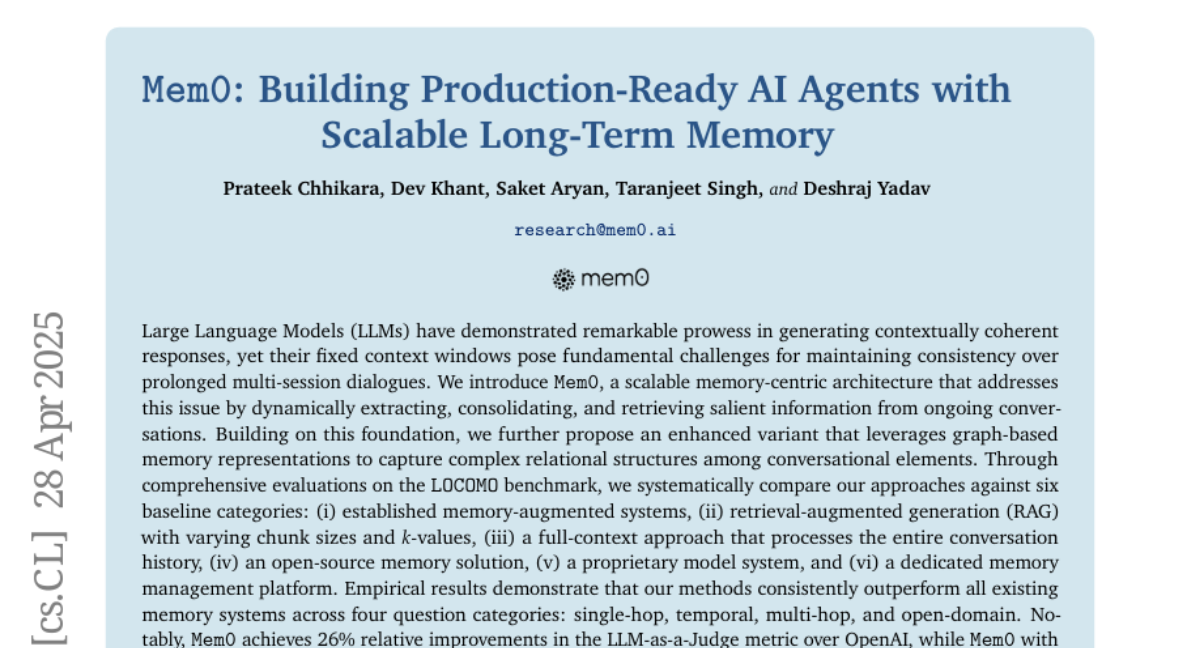
Mem0: Building Production-Ready AI Agents with Scalable Long-Term Memory
Mem0, a memory-centric architecture with graph-based memory, enhances long-term conversational coherence in LLMs by efficiently extracting, consolidating, and retrieving information, outperforming existing memory systems in terms of accuracy and computational efficiency.
· Published on Apr 28, 2025
Submitted by
akhaliq


Submitted by

rajkumarrawal
Recursive Language Models
We study allowing large language models (LLMs) to process arbitrarily long prompts through the lens of inference-time scaling. We propose Recursive Language Models (RLMs), a general inference strategy that treats long prompts as part of an external environment and allows the LLM to programmatically examine, decompose, and recursively call itself over snippets of the prompt. We find that RLMs successfully handle inputs up to two orders of magnitude beyond model context windows and, even for shorter prompts, dramatically outperform the quality of base LLMs and common long-context scaffolds across four diverse long-context tasks, while having comparable (or cheaper) cost per query.
Submitted by
rajkumarrawal
Recursive Language Models
We study allowing large language models (LLMs) to process arbitrarily long prompts through the lens of inference-time scaling. We propose Recursive Language Models (RLMs), a general inference strategy that treats long prompts as part of an external environment and allows the LLM to programmatically examine, decompose, and recursively call itself over snippets of the prompt. We find that RLMs successfully handle inputs up to two orders of magnitude beyond model context windows and, even for shorter prompts, dramatically outperform the quality of base LLMs and common long-context scaffolds across four diverse long-context tasks, while having comparable (or cheaper) cost per query.
Submitted by

andito
Submitted by
andito


Submitted by

RuofengYang
Submitted by
RuofengYang


Submitted by

mervenoyan
Submitted by
mervenoyan
Cosmos 3: Omnimodal World Models for Physical AI
Cosmos 3 is an omnimodal world model that processes and generates multiple data types through a unified mixture-of-transformers architecture, achieving state-of-the-art performance in various understanding and generation tasks.
 NVIDIA
 · Published on Jun 1, 2026
Cosmos 3: Omnimodal World Models for Physical AI
Cosmos 3 is an omnimodal world model that processes and generates multiple data types through a unified mixture-of-transformers architecture, achieving state-of-the-art performance in various understanding and generation tasks.

Submitted by

shanyou92
Kairos: A Native World Model Stack for Physical AI
Kairos is a world model framework that learns from diverse experiences, maintains persistent states through hybrid temporal attention mechanisms, and operates efficiently across different hardware platforms for physical AI applications.
· Published on Jun 16, 2026
Submitted by
shanyou92
Kairos: A Native World Model Stack for Physical AI
Kairos is a world model framework that learns from diverse experiences, maintains persistent states through hybrid temporal attention mechanisms, and operates efficiently across different hardware platforms for physical AI applications.

Submitted by

jiaruz2
Recursive Multi-Agent Systems
RecursiveMAS extends recursive scaling principles from single models to multi-agent systems, enabling collaborative reasoning through iterative latent-space computations with improved efficiency and accuracy.
Submitted by
jiaruz2
Recursive Multi-Agent Systems
RecursiveMAS extends recursive scaling principles from single models to multi-agent systems, enabling collaborative reasoning through iterative latent-space computations with improved efficiency and accuracy.


Submitted by

fdugyt
MOSS-TTS Technical Report
MOSS-TTS is a speech generation model using discrete audio tokens and autoregressive modeling with capabilities for voice cloning, pronunciation control, and long-form generation across multiple languages.
Submitted by
fdugyt
MOSS-TTS Technical Report
MOSS-TTS is a speech generation model using discrete audio tokens and autoregressive modeling with capabilities for voice cloning, pronunciation control, and long-form generation across multiple languages.

Submitted by

zbhpku
Submitted by
zbhpku


LightRAG: Simple and Fast Retrieval-Augmented Generation
LightRAG improves Retrieval-Augmented Generation by integrating graph structures for enhanced contextual awareness and efficient information retrieval, achieving better accuracy and response times.
- 5 authors
· Published on Oct 8, 2024

Submitted by

jasonrqh
Submitted by
jasonrqh


Submitted by

nielsr
Submitted by
nielsr

Submitted by

ChrisDing1105
Submitted by
ChrisDing1105

Submitted by

unilm
VibeVoice Technical Report
VibeVoice synthesizes long-form multi-speaker speech using next-token diffusion and a highly efficient continuous speech tokenizer, achieving superior performance and fidelity.
Submitted by
unilm
VibeVoice Technical Report
VibeVoice synthesizes long-form multi-speaker speech using next-token diffusion and a highly efficient continuous speech tokenizer, achieving superior performance and fidelity.

Submitted by
taesiri
Submitted by
taesiri

Submitted by

MoeinAbtahi
Submitted by
MoeinAbtahi

Submitted by

chengtan9907
PaperFlow: Profiling, Recommending, and Adapting Across Daily Paper Streams
PaperFlow is a framework for scientific paper recommendation that processes user profiles, daily paper streams, and interest drift through three stages: profiling, recommending, and adapting, using a longitudinal benchmark with 24 users, 50 daily streams, and 1,200 episodes.
Submitted by
chengtan9907
PaperFlow: Profiling, Recommending, and Adapting Across Daily Paper Streams
PaperFlow is a framework for scientific paper recommendation that processes user profiles, daily paper streams, and interest drift through three stages: profiling, recommending, and adapting, using a longitudinal benchmark with 24 users, 50 daily streams, and 1,200 episodes.

Submitted by
akhaliq
Very Large-Scale Multi-Agent Simulation in AgentScope
Enhancements to the AgentScope platform improve scalability, efficiency, and ease of use for large-scale multi-agent simulations through distributed mechanisms, flexible environments, and user-friendly tools.
· Published on Jul 25, 2024
Submitted by
akhaliq

Submitted by

cmhungsteve
Submitted by
cmhungsteve

Submitted by

Paranioar
Submitted by
Paranioar
Submitted by

yhshu
Submitted by
yhshu
Submitted by
akhaliq
Submitted by
akhaliq

Submitted by

VigneshHexo
SIA: Self Improving AI with Harness & Weight Updates
A self-improving AI framework simultaneously updates both model weights and task-specific agent architecture through a language-model feedback agent across legal classification, GPU optimization, and biological data denoising tasks.
 Hexo AI
 · Published on May 26, 2026
Submitted by
VigneshHexo
SIA: Self Improving AI with Harness & Weight Updates
A self-improving AI framework simultaneously updates both model weights and task-specific agent architecture through a language-model feedback agent across legal classification, GPU optimization, and biological data denoising tasks.


Submitted by
taesiri
Submitted by
taesiri

Submitted by

Rbin
RAG-Anything: All-in-One RAG Framework
RAG-Anything is a unified framework that enhances multimodal knowledge retrieval by integrating cross-modal relationships and semantic matching, outperforming existing methods on complex benchmarks.
Submitted by
Rbin
RAG-Anything: All-in-One RAG Framework
RAG-Anything is a unified framework that enhances multimodal knowledge retrieval by integrating cross-modal relationships and semantic matching, outperforming existing methods on complex benchmarks.

Submitted by

hao-li
Agent READMEs: An Empirical Study of Context Files for Agentic Coding
Agentic coding tools receive goals written in natural language as input, break them down into specific tasks, and write or execute the actual code with minimal human intervention. Central to this process are agent context files ("READMEs for agents") that provide persistent, project-level instructions. In this paper, we conduct the first large-scale empirical study of 2,303 agent context files from 1,925 repositories to characterize their structure, maintenance, and content. We find that these files are not static documentation but complex, difficult-to-read artifacts that evolve like configuration code, maintained through frequent, small additions. Our content analysis of 16 instruction types shows that developers prioritize functional context, such as build and run commands (62.3%), implementation details (69.9%), and architecture (67.7%). We also identify a significant gap: non-functional requirements like security (14.5%) and performance (14.5%) are rarely specified. These findings indicate that while developers use context files to make agents functional, they provide few guardrails to ensure that agent-written code is secure or performant, highlighting the need for improved tooling and practices.
- 11 authors
· Published on Nov 17, 2025
Submitted by
hao-li
Agent READMEs: An Empirical Study of Context Files for Agentic Coding
Agentic coding tools receive goals written in natural language as input, break them down into specific tasks, and write or execute the actual code with minimal human intervention. Central to this process are agent context files ("READMEs for agents") that provide persistent, project-level instructions. In this paper, we conduct the first large-scale empirical study of 2,303 agent context files from 1,925 repositories to characterize their structure, maintenance, and content. We find that these files are not static documentation but complex, difficult-to-read artifacts that evolve like configuration code, maintained through frequent, small additions. Our content analysis of 16 instruction types shows that developers prioritize functional context, such as build and run commands (62.3%), implementation details (69.9%), and architecture (67.7%). We also identify a significant gap: non-functional requirements like security (14.5%) and performance (14.5%) are rarely specified. These findings indicate that while developers use context files to make agents functional, they provide few guardrails to ensure that agent-written code is secure or performant, highlighting the need for improved tooling and practices.
- 11 authors
· Nov 17, 2025